News
Gemini 4 Hydrogen now runs Google Search's AI answers
Google made Gemini 4 Hydrogen the default in AI Mode and for hard AI Overview questions on November 12. What changes, who gets cited, and how to measure it.

· 7 min read
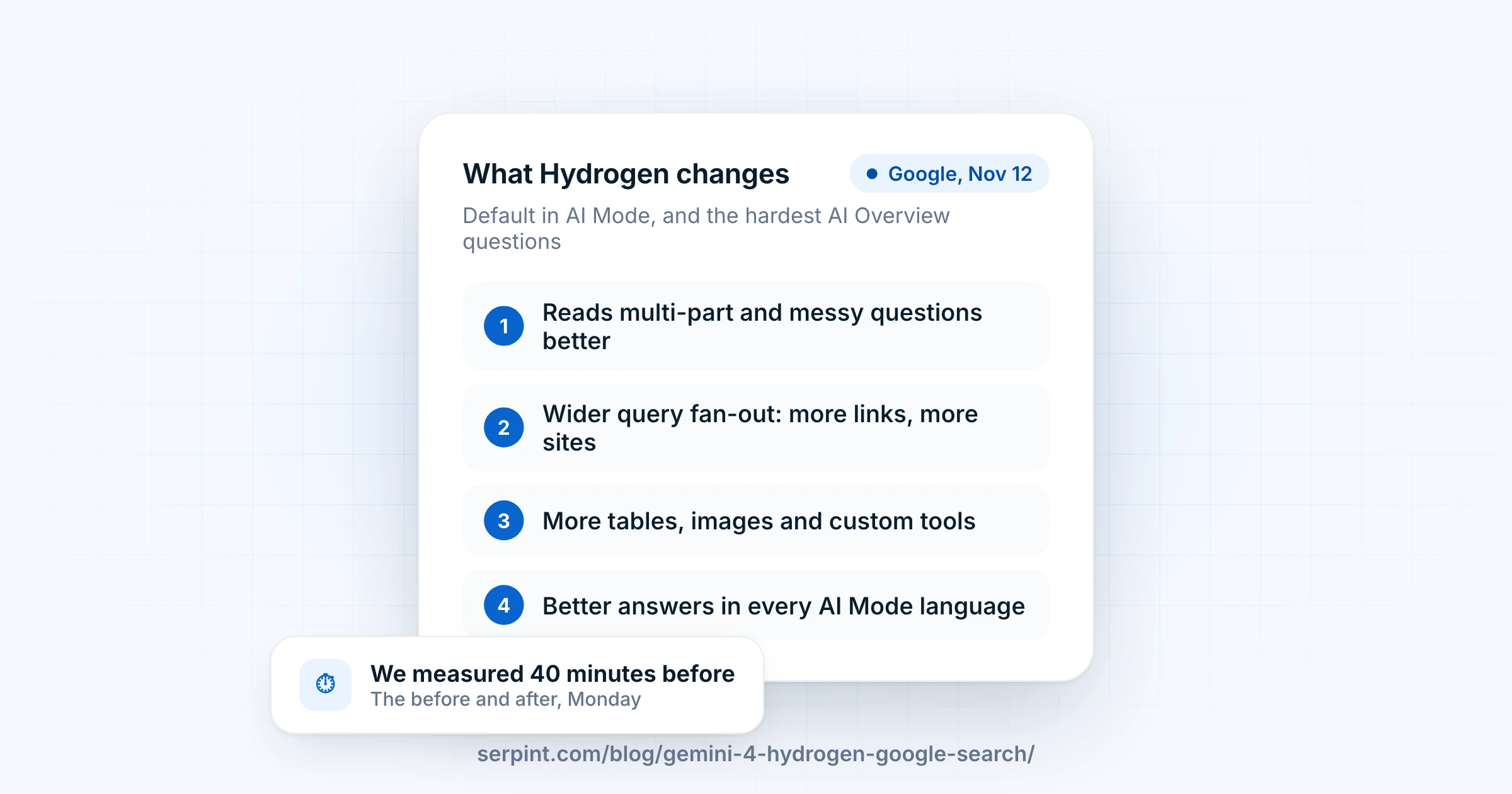
Google made Gemini 4 Hydrogen the model behind its AI answers on November 12, 2026. It’s now the default in AI Mode for everyone and answers the hardest AI Overview questions. Google calls it “the biggest model upgrade to Search yet” and promises more links to more sites, which is the claim we’ll measure.
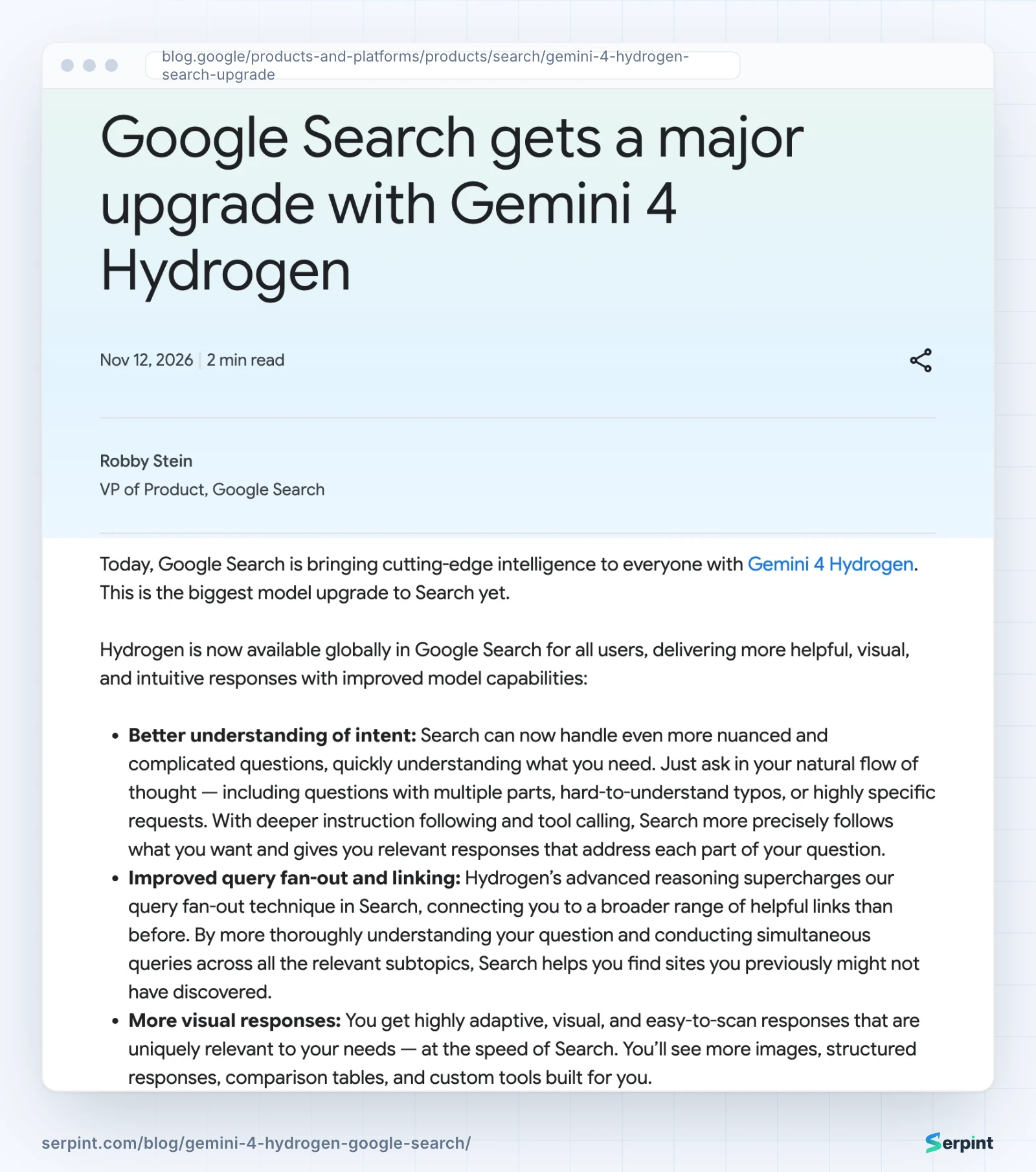
Google’s announcement on its blog, November 12, 2026.
✅ My advice Write November 12 next to November 10 in your notes. The core update started two days earlier, so read your rankings and your AI Overview citations separately this month, and don’t rewrite pages for Hydrogen until you’ve seen what it cites.
Google’s post is short, so it’s worth reading exactly what it claims.
What did Google change in Search?
Google changed the model that writes AI Mode’s answers and some AI Overviews, not the rankings. Robby Stein, Google’s VP of Product for Search, said on X that Hydrogen is now “the new default model in AI Mode” and is used for “your hardest questions in AI Overviews”.
Google’s post lists four improvements. Hydrogen understands multi-part questions, typos and very specific requests better. It runs a wider query fan-out and links to “a broader range of helpful links than before”. Answers get more images, comparison tables and custom tools, and better language support across AI Mode.
The model is available worldwide, for all users, from the day of the post. What Google didn’t publish is just as useful: no count of links or sites, no list of which AI Overview questions count as “hardest”, and no word on what Hydrogen replaced.
Hydrogen is the latest of five model changes in Google’s AI answers this year.
Where does Hydrogen fit among Google’s models?
Hydrogen is the first Gemini 4 model every Google user gets. The two before it, Argon and Carbon, went only to paying subscribers in AI Mode, in October and two days before Hydrogen.
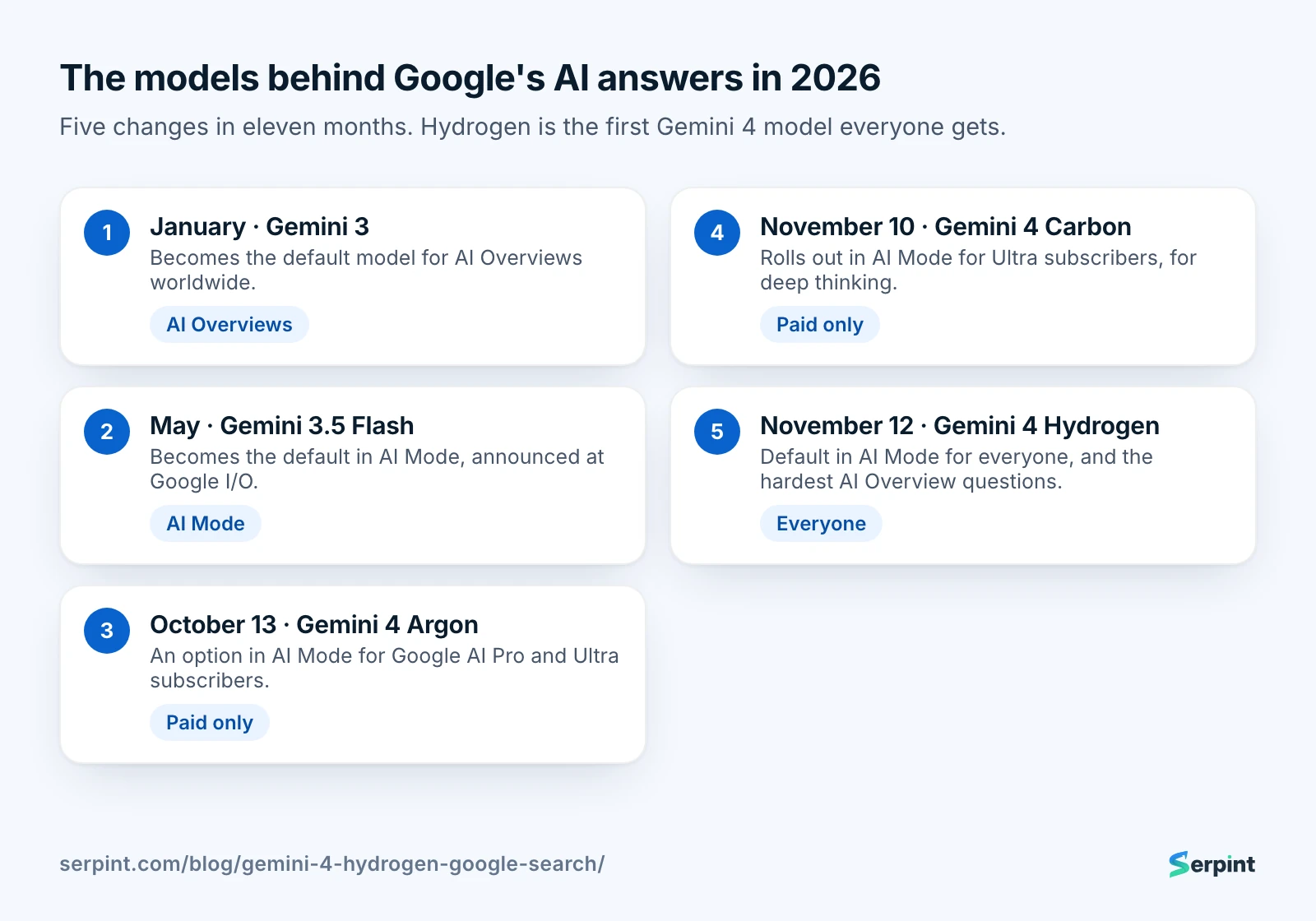
From Search Engine Journal’s reporting on each change.
Five changes in eleven months means your AI Overview data has a model change in it every few months. Google designed Hydrogen for speed, and Carbon and Argon for longer thinking, so Hydrogen is the one that runs at the scale of Search.
The change that matters most to site owners is the second item on Google’s list.
What does “more links” mean for your site?
“More links” means Hydrogen’s answers can cite pages that don’t rank for the question itself. Google gets there with query fan-out: it splits one question into many searches on its subtopics, runs them at once, and cites sources from all of them.
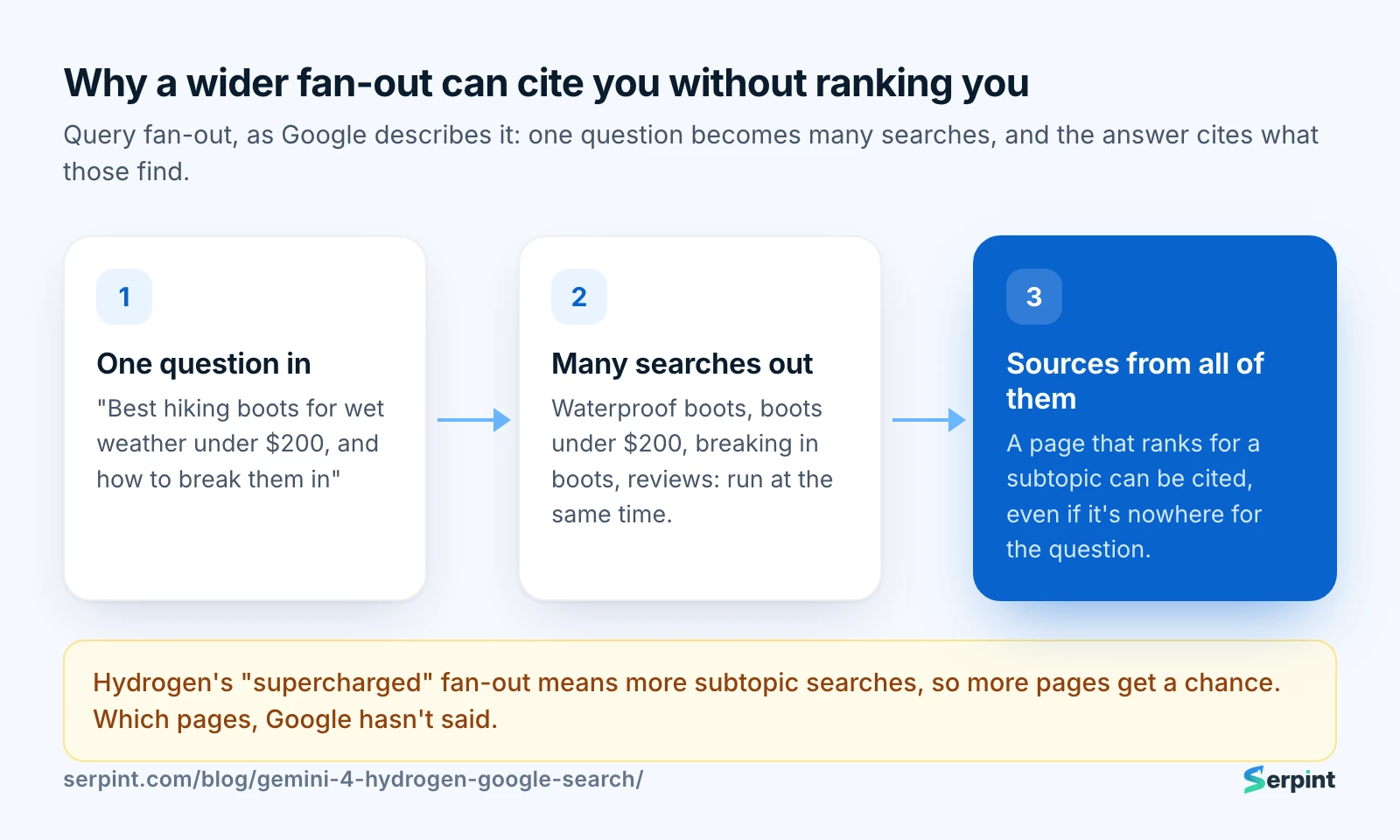
How query fan-out works, with a sample question.
Google says Hydrogen “supercharges” that fan-out. More subtopic searches mean more pages get a chance to be cited. They also mean the pages that rank first for your keyword have more competition inside the answer.
💡 My take A wider fan-out rewards pages that answer one subtopic plainly: the break-in time, the price range, the one comparison someone asked about. A page that ranks for the whole question but buries those answers is easier for the model to skip.
That’s a claim, not a measurement yet, so here’s what I expect it to do.
What do I expect Hydrogen to change?
I expect more sources per answer and more citations from outside the top 10. Those are the two bets our data can test on Monday.
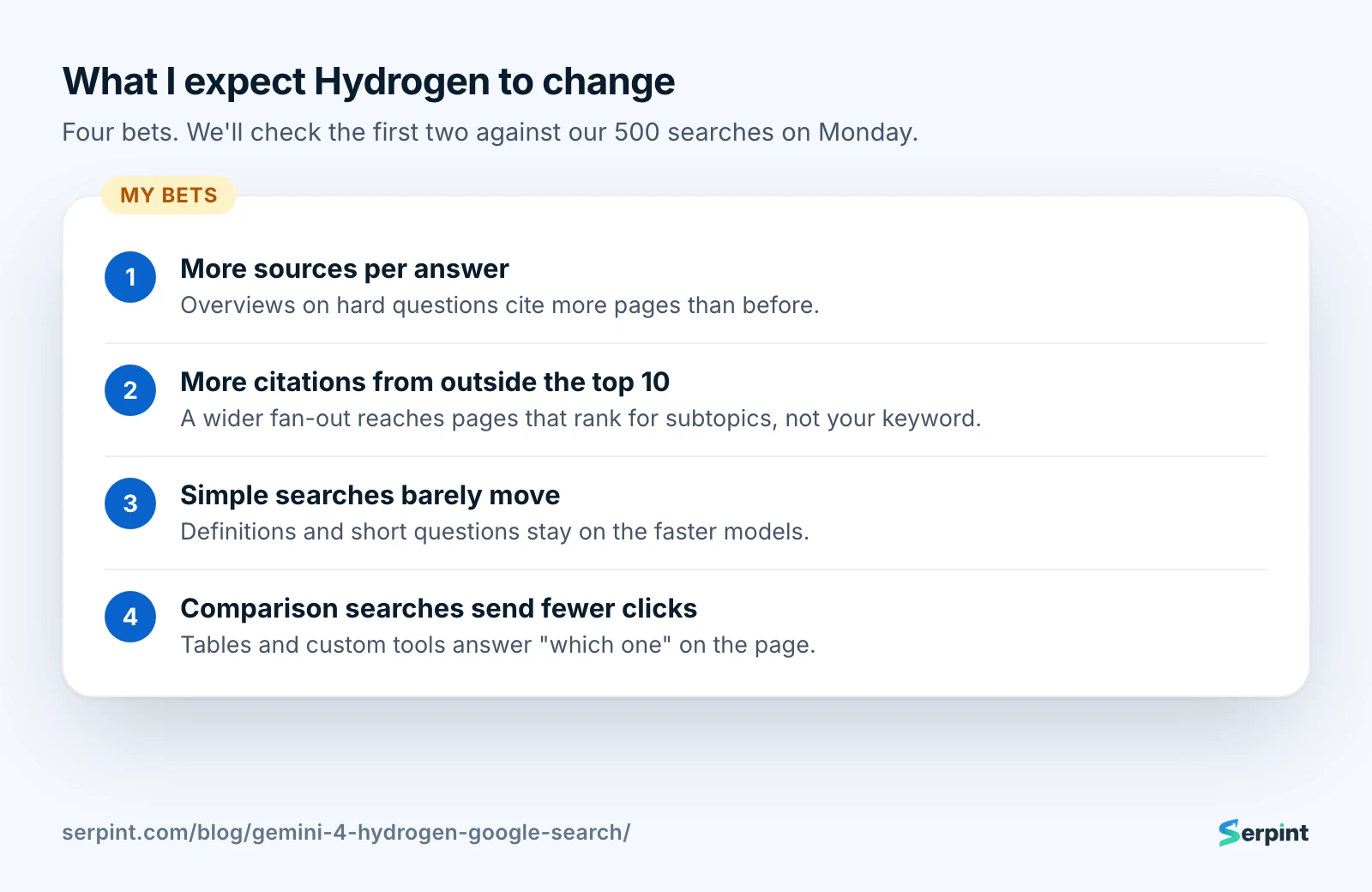
- More sources per answer. A wider fan-out finds more pages, and Google says Hydrogen shows more links. Overviews on hard questions should cite more pages than before.
- More citations from outside the top 10. Fan-out searches subtopics, not your keyword, so more cited pages should come from beyond the keyword’s own top 10.
- Simple searches barely move. Stein says Hydrogen takes the hardest AI Overview questions. Definitions and short questions likely stay on faster models.
- Comparison searches send fewer clicks. Google promises comparison tables and custom tools, which answer “which one should I buy” on the results page itself.
The first two need a before and an after. We happen to have the before.
How will we know what changed?
We’ll know by fetching the same 500 US results pages again. We pulled them fresh at 16:47 UTC on November 12, 2026, for our AI Overview study, about 40 minutes before Google’s post went up.
That’s as close to a pre-Hydrogen baseline as anyone outside Google will have. On Monday, November 16, we publish the study with both: how often AI Overviews show, what they cite, and what moved after Hydrogen.
One caution I’ll apply to our own numbers. The November core update started on November 10 and is still rolling out, so rankings are moving at the same time.
How do you tell Hydrogen from the core update?
You tell them apart by what each one moves. The core update moves rankings: your positions and your clicks from classic results. Hydrogen moves AI answers: whether an AI Overview or AI Mode cites you, and how many other sites it cites next to you.
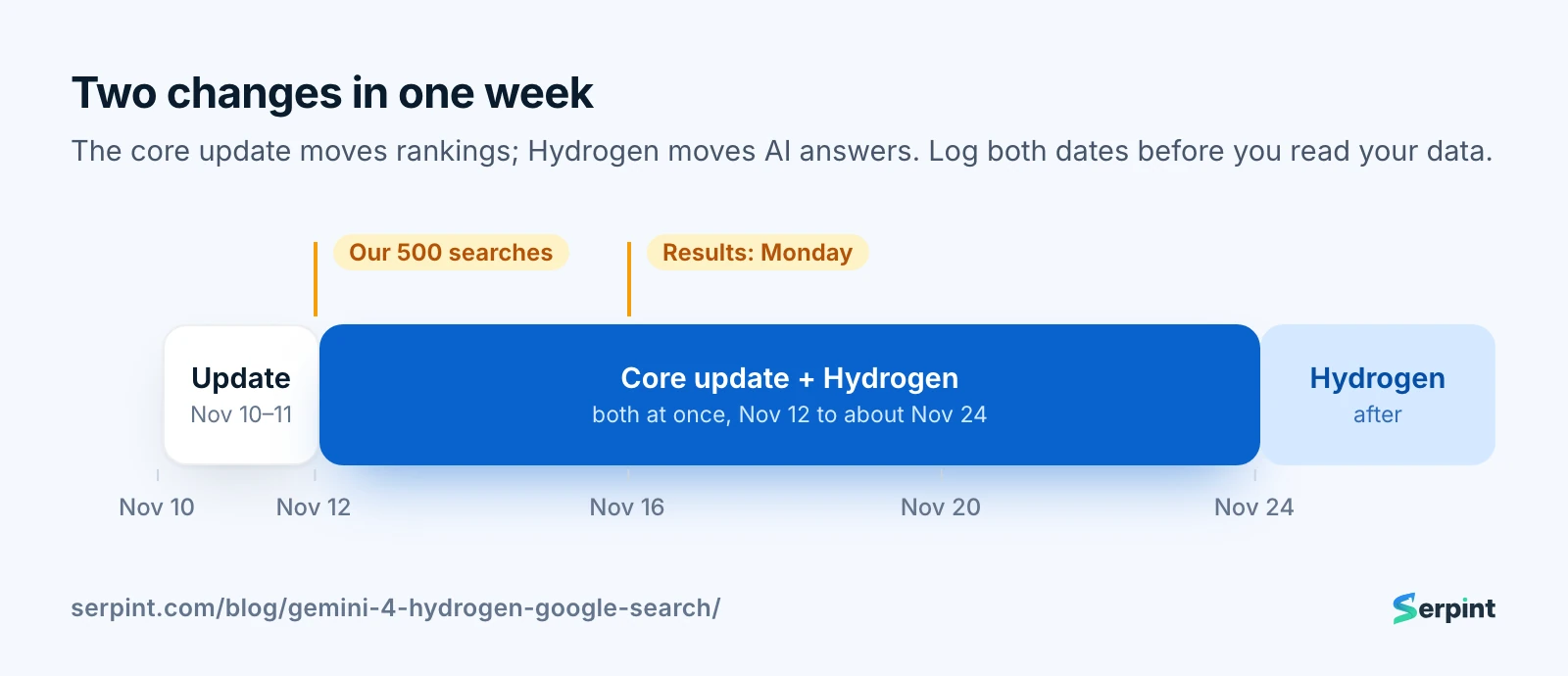
Dates from Google’s Search Status incident and its post.
So read the two separately. A page that held its position but lost its AI Overview citation points to Hydrogen. A page that dropped from #3 to #9 points to the core update.
Search Console won’t split them for you. It counts AI feature clicks inside its Web totals, and its Generative AI report shows impressions only. Your own record of which keywords cite you, week by week, is what shows the change.
How can Serpint show what Hydrogen changed for you?
Serpint records, for every keyword you track, whether Google shows an AI Overview and whether that overview cites your site. Compare the checks before and after November 12, and the keywords that lost or gained a citation are the ones Hydrogen touched.
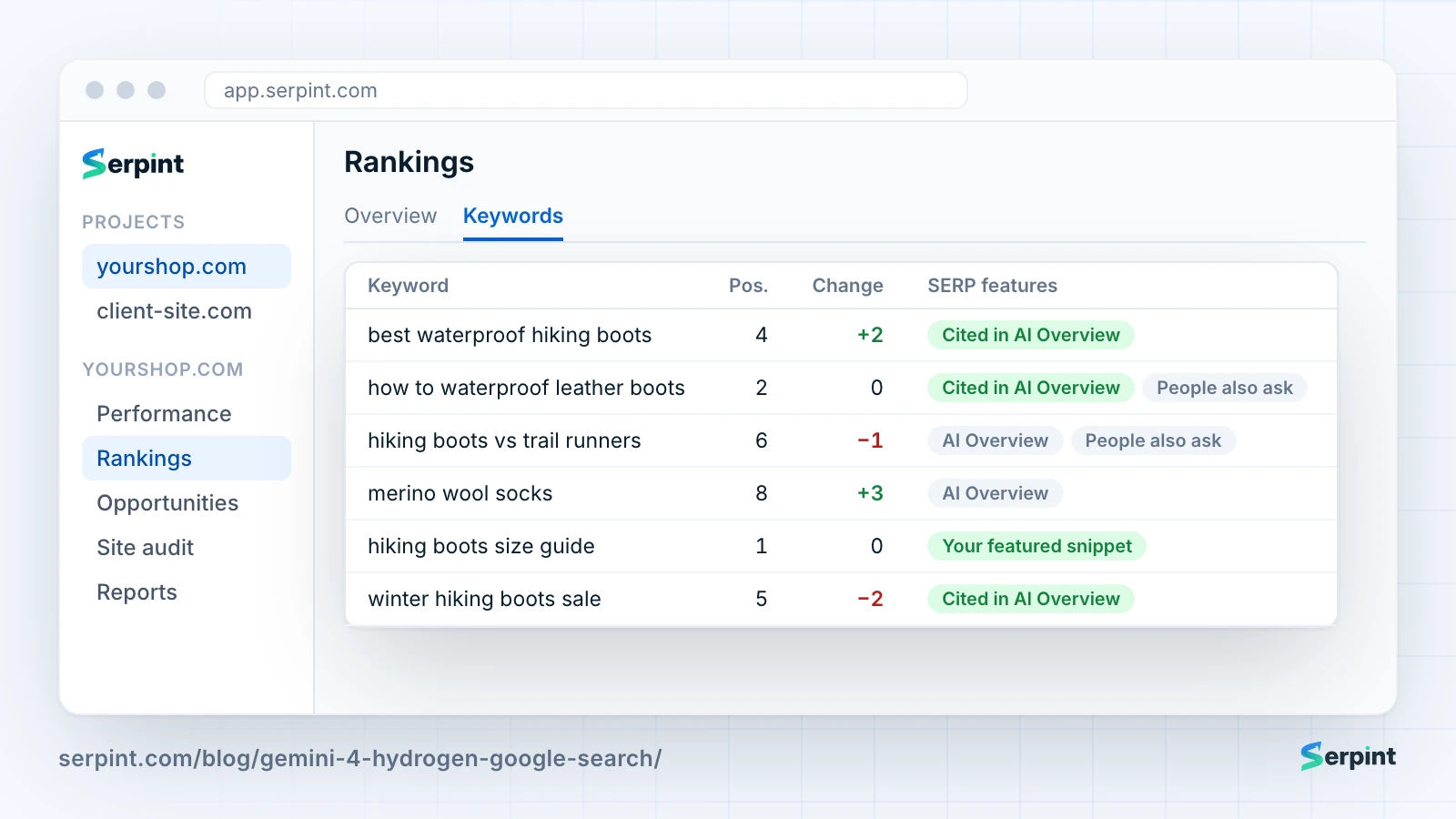
On daily tracking, overviews that load late are read in full at the weekly check, so compare after the first weekly check past November 12. Positions sit in the same row, which is how you keep the core update apart.
Opportunities lists “Snippets & AI”: keywords in your top 10 where the AI Overview doesn’t cite you. Those are the pages to give a plain, quotable answer near the top.
How much Hydrogen changes depends on the kind of site you run.
What does it mean for your kind of site?
Affiliate and review sites are most exposed. Comparison tables and custom tools go straight at “best” and “vs” searches, so watch those keywords’ citations and clicks first.
Publishers and how-to sites may gain. Long, multi-part questions are what Hydrogen handles better, and a wider fan-out needs more pages that answer each step.
Online stores should watch product comparisons. A table inside the answer can name your product without a click; being in it still beats being left out.
Whatever your site, this week’s steps are the same.
What don’t we know yet?
We don’t know which AI Overview questions count as “hardest”, so we can’t say how many overviews Hydrogen writes. Google gave no link or citation counts, and didn’t say which model it replaced.
We also don’t know how Hydrogen interacts with the core update. The rollout should end around November 24, and only after that will either change be clean to read.
What should you do now?
Write down November 10 and November 12, and keep this month’s ranking changes and AI citation changes in separate columns.
Then hold off on rewriting pages for Hydrogen. Check which of your keywords lost or gained an AI Overview citation over the next week.
Finally, read our study on Monday, November 16, for the before and after on 500 searches. It’ll show whether “more links” means more sites like yours.
Founder of Serpint
Founder of Serpint. 6+ years in SEO and content marketing and 2 in GTM engineering, most recently as Head of Product and Content at lobstr.io, a B2B SaaS web scraping platform, until October 2026. Writes about SEO, AEO and GEO, the full stack of search and AI answer optimization, and content marketing.