News
How Google picks AI Overview links: we tested its new doc
Google explained how AI Overviews pick their links on November 24. We tested it on 636 US overviews the same day; here's what holds, and what to change.

· 10 min read
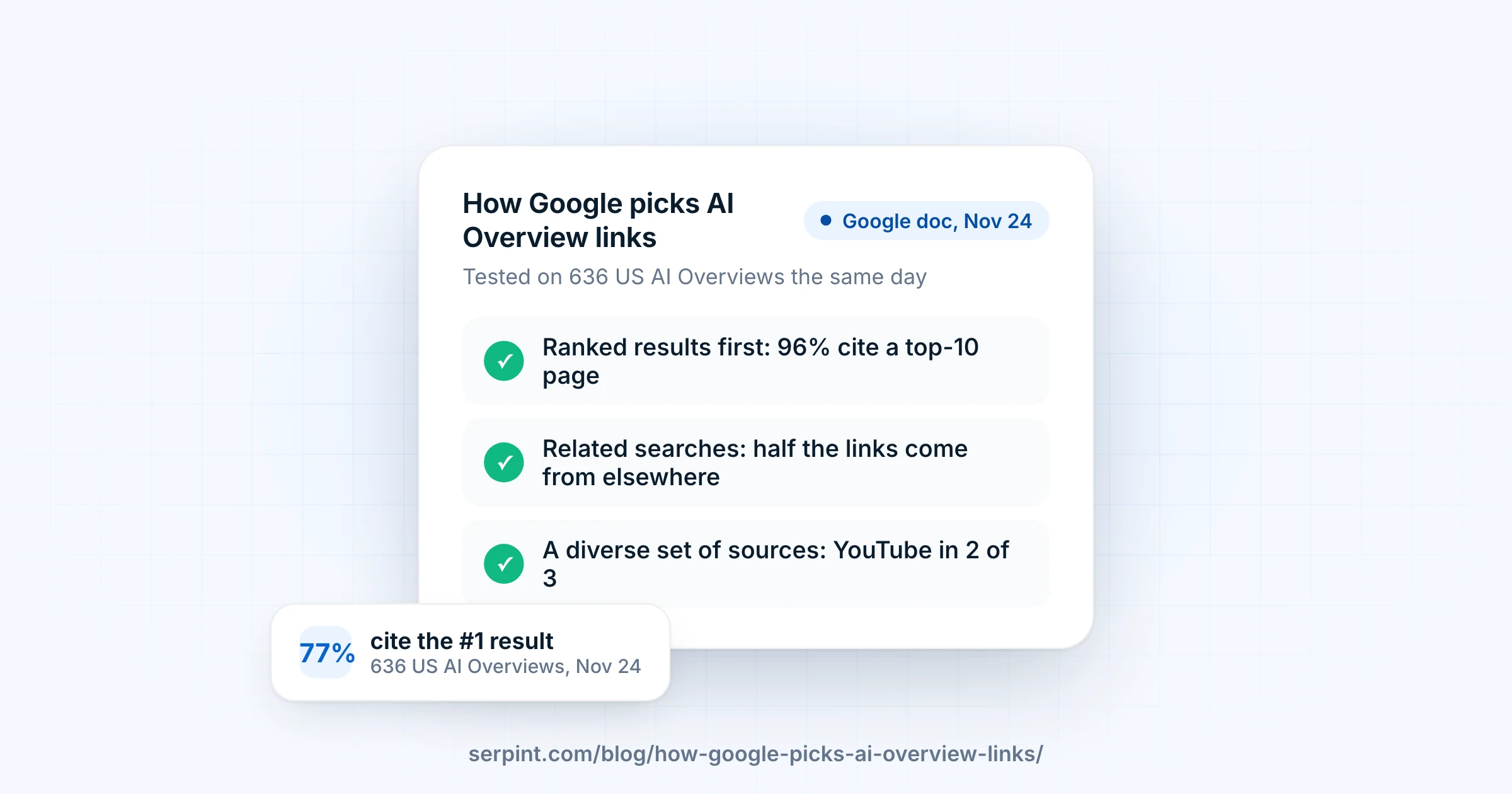
Google published a page on November 24, 2026 explaining how AI Overviews and AI Mode pick their links. We tested it on 636 US AI Overviews from the same afternoon. Ranking in the top 10 matters most, but only half the links go to top-10 pages, and YouTube shows up in two of every three overviews.
✅ My advice Rank first, because 96% of overviews cite a top-10 page. Then cover the parts of the question your page skips: those sub-questions are where the other half of the links come from.
What does Google’s new page say about AI Overview links?
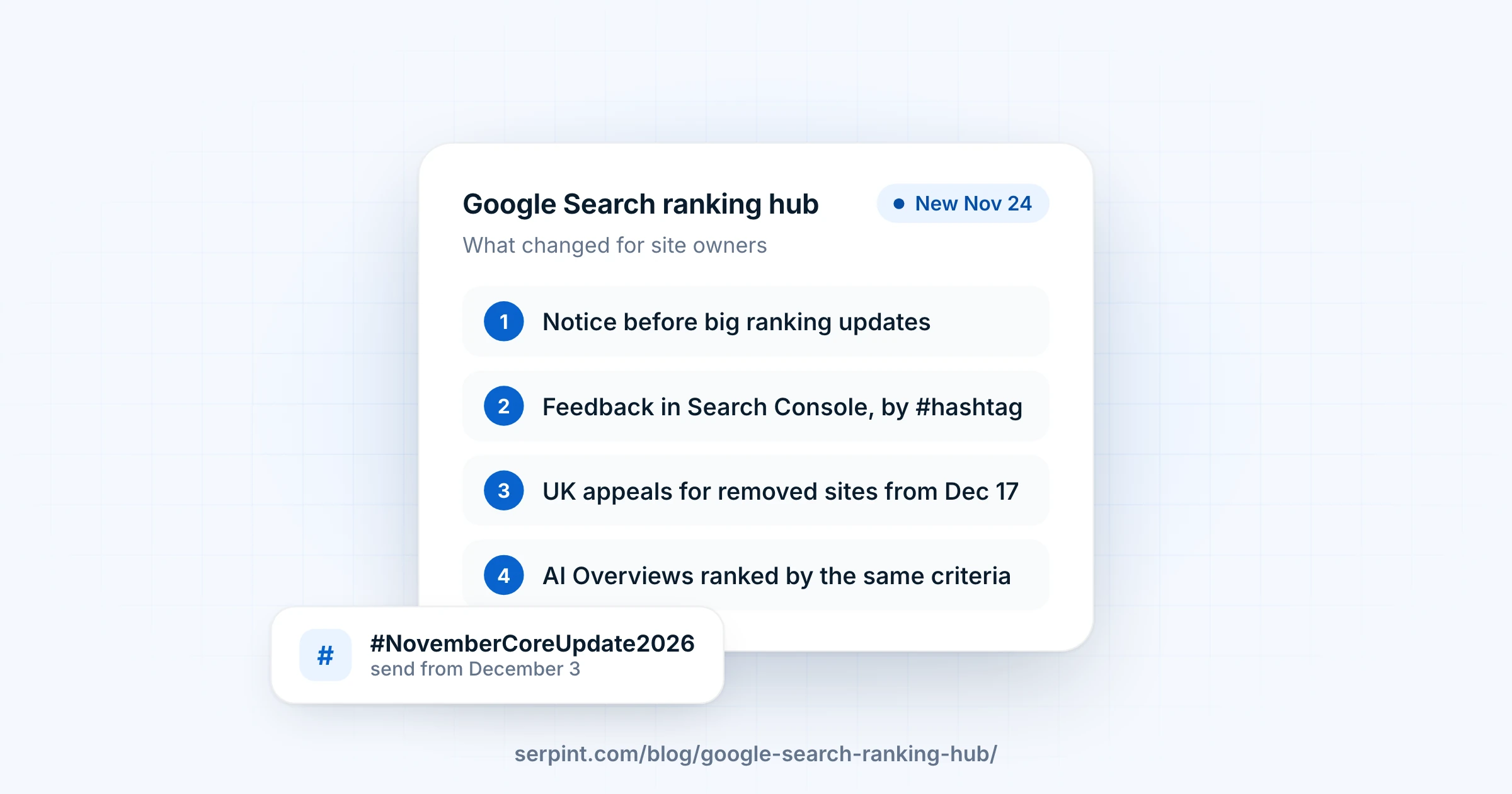
Google’s page says AI Overviews start from the results that already rank. Its title is “Attribution and factuality in Search generative AI features”, and it came out with Google’s new ranking hub, which collects how Google ranks, announces updates and takes feedback.
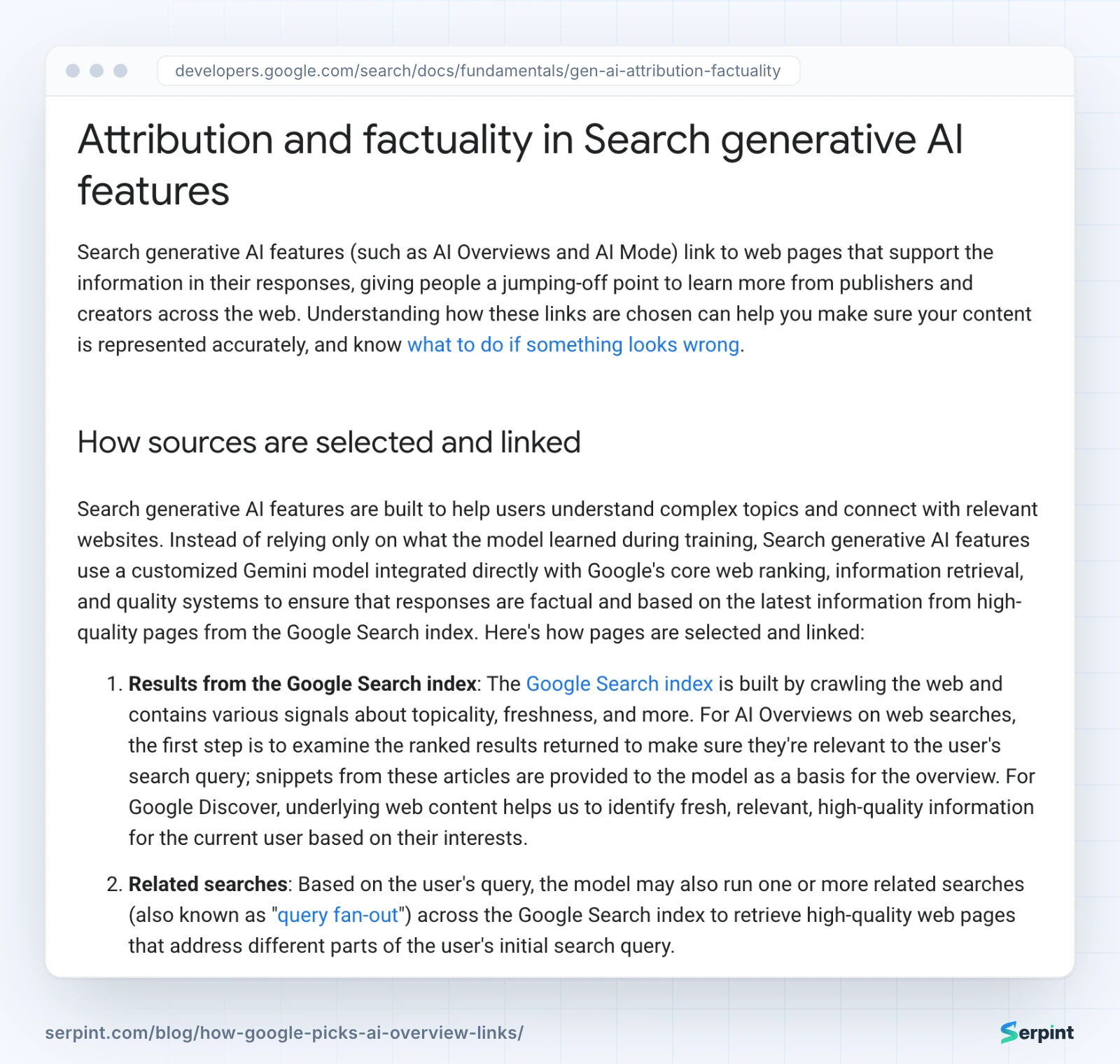
Google’s new page, captured November 26, 2026.
The page describes four steps. First, Google checks the ranked results for your search and hands their snippets to the model. Second, the model “may also run one or more related searches”, the query fan-out, to cover other parts of the question.
Third, it writes the answer and links the pages that support it. Fourth, it picks which links to show, balancing ranking signals with a layout that reads well and “a diverse set of helpful sources”.
Before an answer shows, Google says it applies “an even higher bar” to sensitive health and money topics and may show no answer at all. Each of those claims can be checked against real overviews, so we did.
Do AI Overviews really cite the pages that rank?
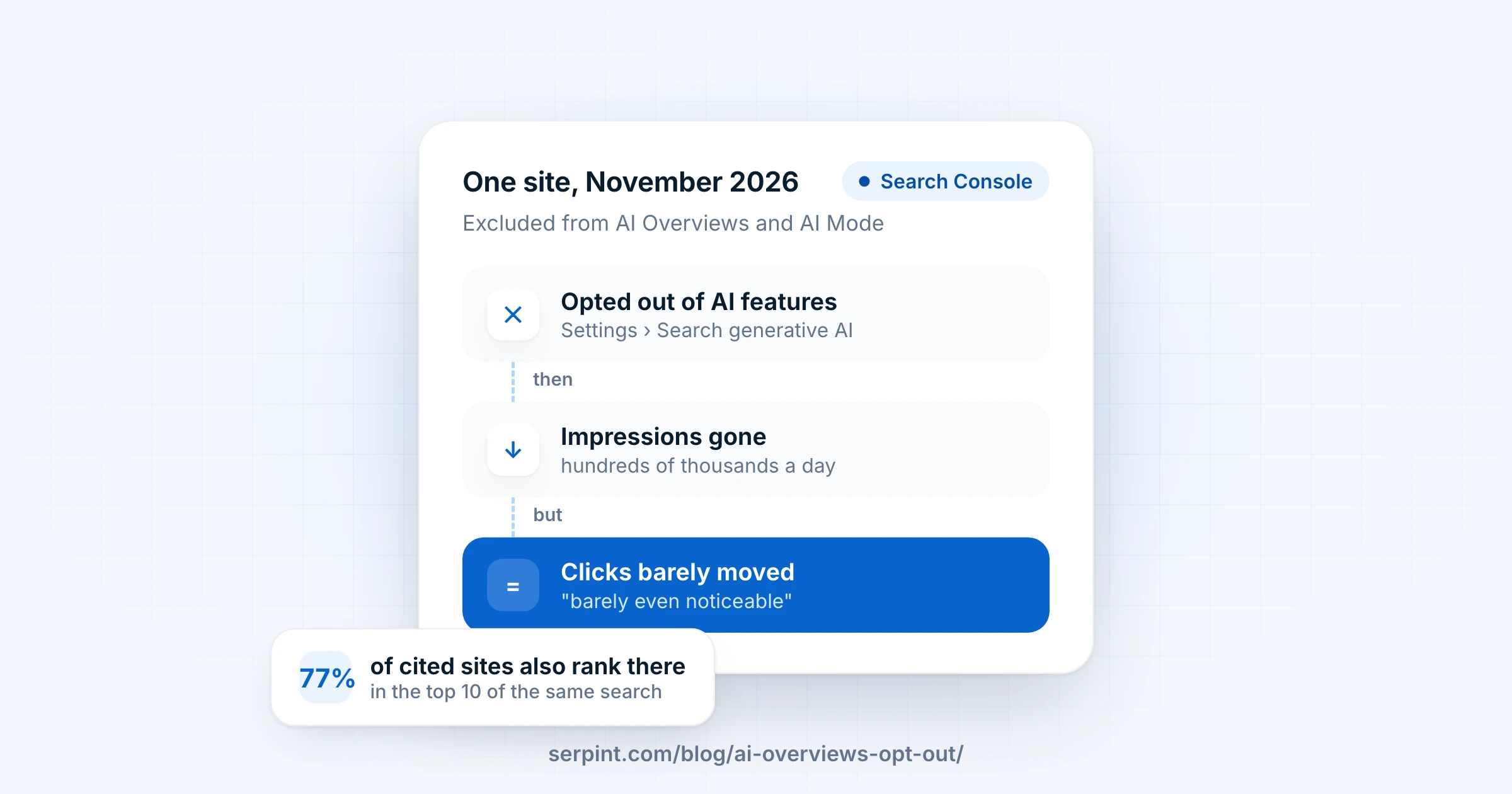
AI Overviews do cite the pages that rank, and far more than we first measured. Of the 636 overviews, 96.7% cited at least one page from the clean top 10 of the same search, and 77.2% cited the #1 result. An overview used 4.4 of the ten ranking pages on average.
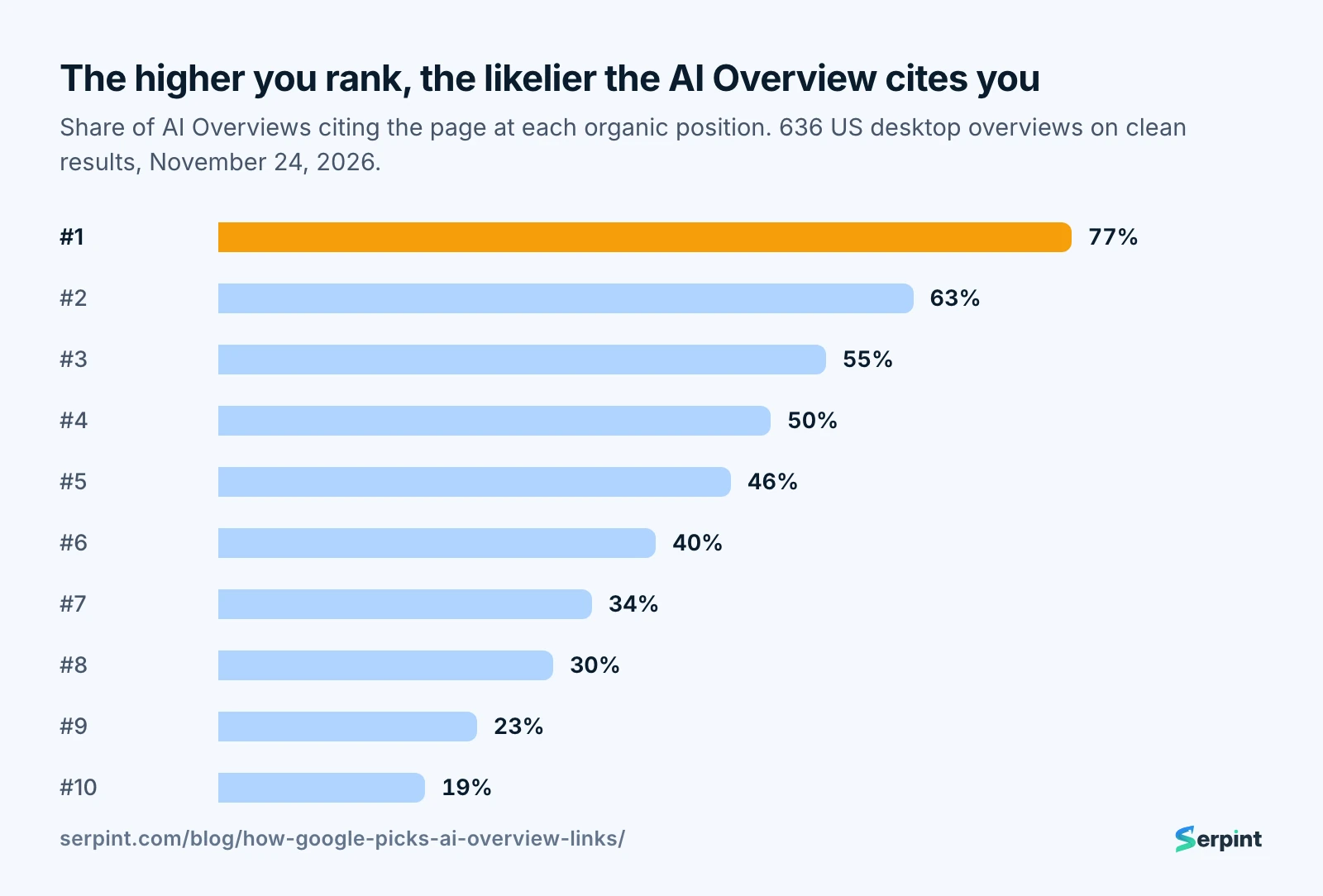
Data: Serpint’s check of 1,500 US desktop searches, November 24, 2026.
The odds fall with every position, from 77% at #1 to 19% at #10. That’s what “the first step is to examine the ranked results” looks like from outside. I read it as Google describing a pipeline that starts with rankings, and the numbers back it.
These figures use results fetched with Google’s “poisoned” pages filtered out, which matters. Our first study compared overviews with tampered top 10s and found a far weaker link, so we corrected the AI Overview statistics on November 24.
Ranking gets you into the pool. It doesn’t explain the other half of the links, though.
Where do the other half of the links come from?
The other half of the links come from pages that aren’t in the top 10 at all. Only 48.3% of the 5,894 citations pointed to a top-10 page; YouTube took 15.2%, other sites 14.8%, Google’s own pages 13.4% and other pages on ranking sites 8.2%.
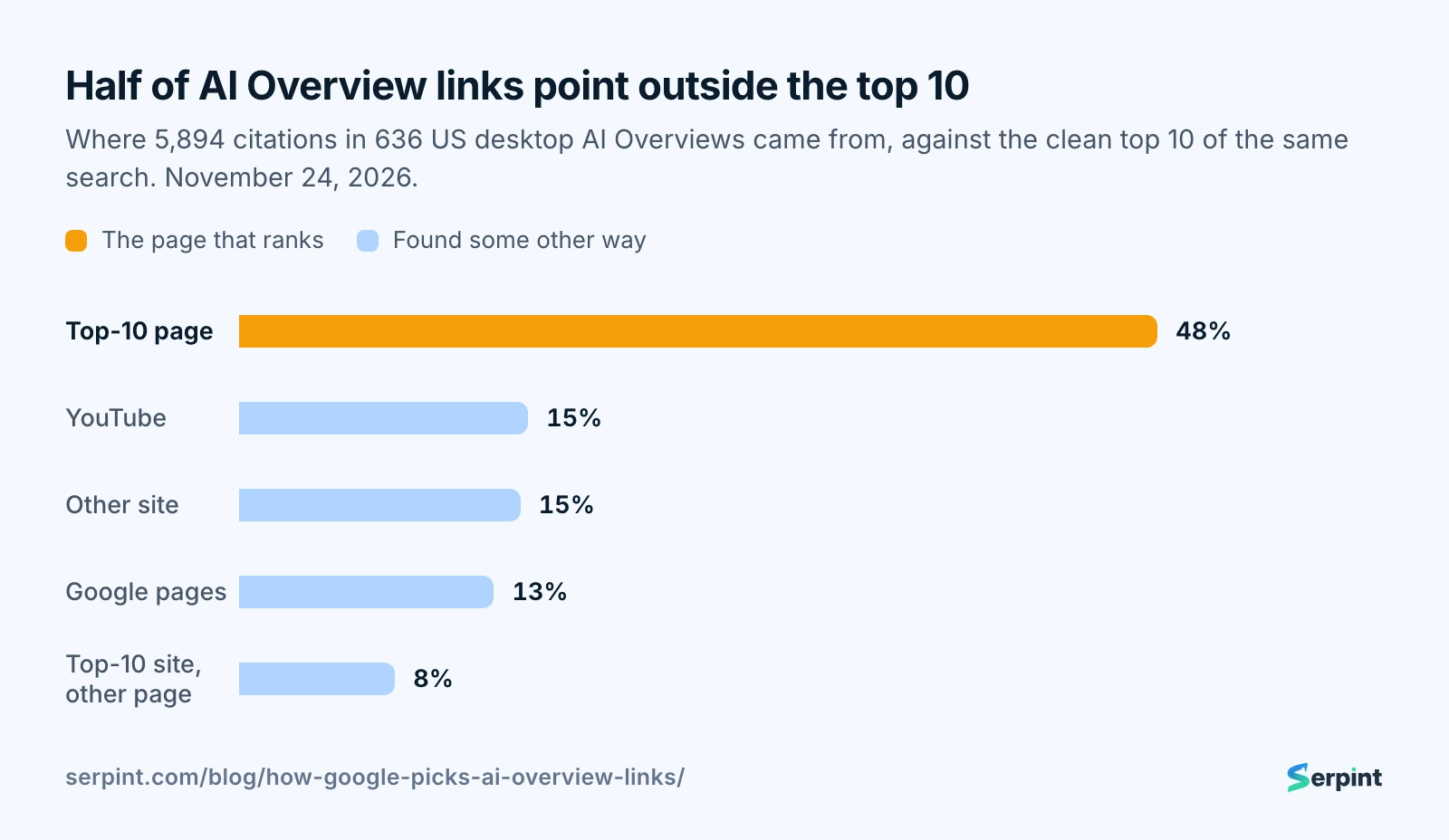
Data: Serpint’s check of 1,500 US desktop searches, November 24, 2026.
That’s the fan-out at work. In 83.6% of overviews at least one link went to a site that wasn’t ranking for the search, and 66.8% did even leaving YouTube and Google out. Only 4.2% of overviews cited nothing but the top 10.
The sites picked up this way are mostly social and reference sites: Facebook, Instagram, Reddit and Wikipedia lead, then a long tail of publishers. A page can earn a link without ranking for your keyword, as long as it ranks for one of the questions Google asks next.
💡 My take Google’s page is honest about the order and quiet about the share. The top 10 is the ticket, not the seat: half the seats go to pages that answer the follow-up questions, and to YouTube.
YouTube’s share is the biggest surprise in our data, so it gets its own look.
Why is YouTube in so many AI Overviews?
YouTube is in so many AI Overviews because Google treats a video as a source like any other page. In our check, 65.7% of overviews cited youtube.com. Profound, in data published on November 24, found YouTube the most-cited site in AI Overviews, at 37.2% of answers.
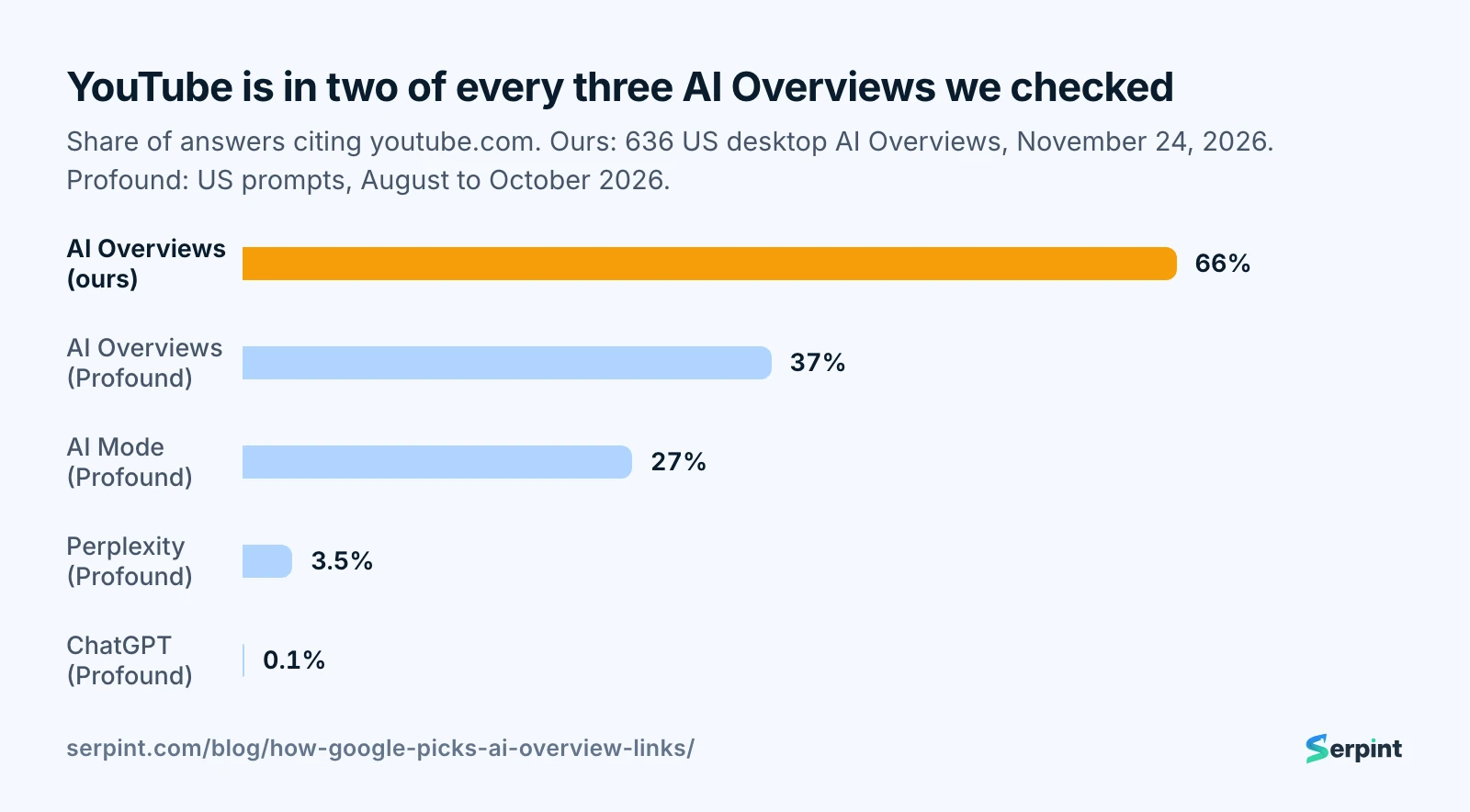
Data: Serpint, November 24, 2026; Profound, August to October 2026.
The gap between us is about method. Profound tracks longer, chat-style prompts; we checked short keyword searches, the kind people still type into Google. Both agree on the point that matters: outside Google, YouTube barely registers, with ChatGPT citing it in 0.1% of answers.
Video wins some searches far more than others. YouTube was in 82% of how-to overviews and 81% of comparisons, but 47% of price searches and 45% of brand searches.
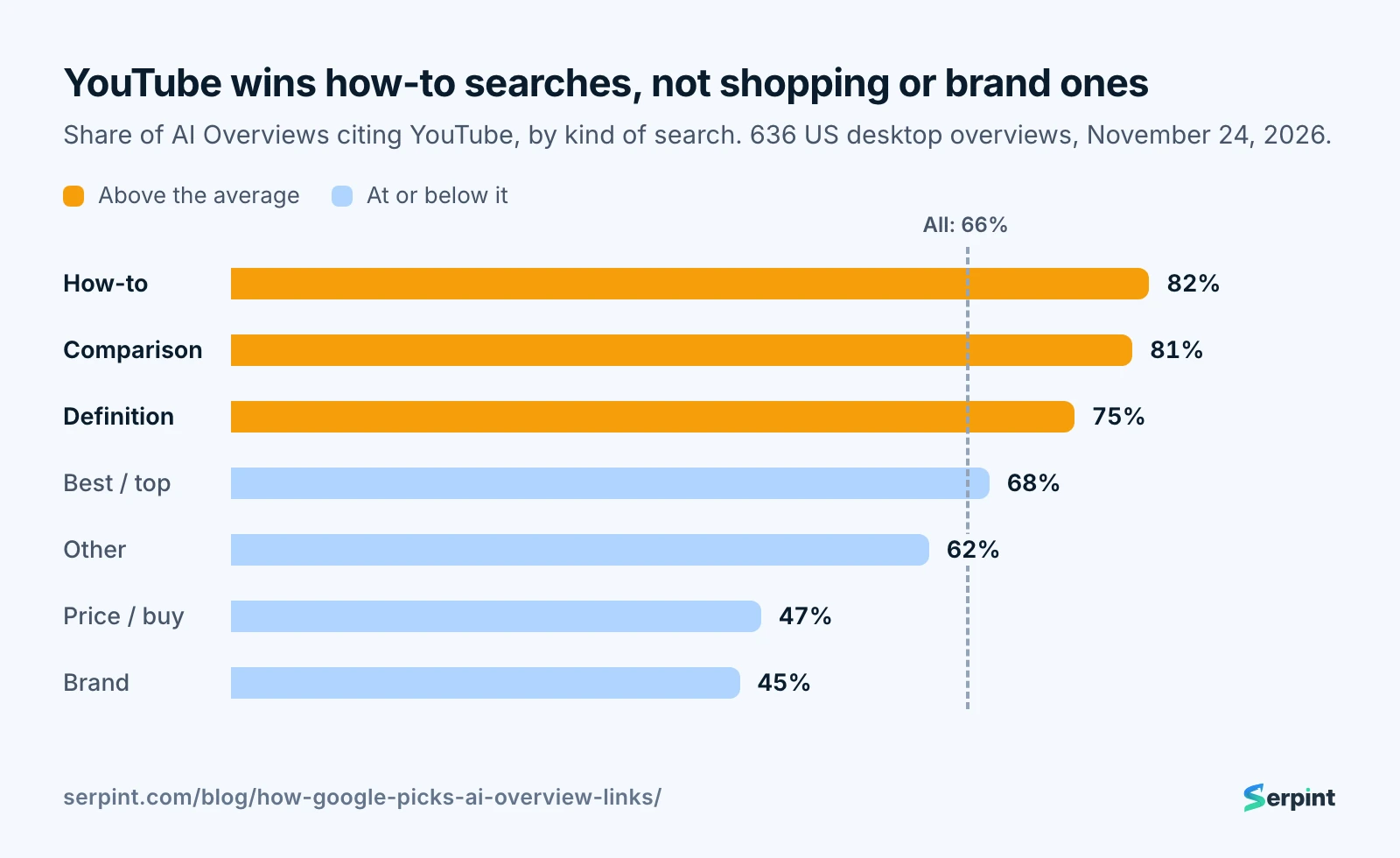
Data: Serpint’s check of 1,500 US desktop searches, November 24, 2026.
There’s a catch. YouTube links sit lower in the list than others: 14.3% of them were in the first three cards, against 32.4% of all citations. Google cites the video, then tucks it behind Show all.
I think video is the cheapest way into an overview for how-to and comparison searches. That leads to the last of Google’s claims: a “diverse set” of sources.
How diverse are the sources Google picks?
The sources are less diverse than Google’s wording suggests. A typical overview had 9 links from 7 sites, and 76.4% cited at least one site twice or more. A quarter of overviews (25.9%) linked to Google’s own search pages.
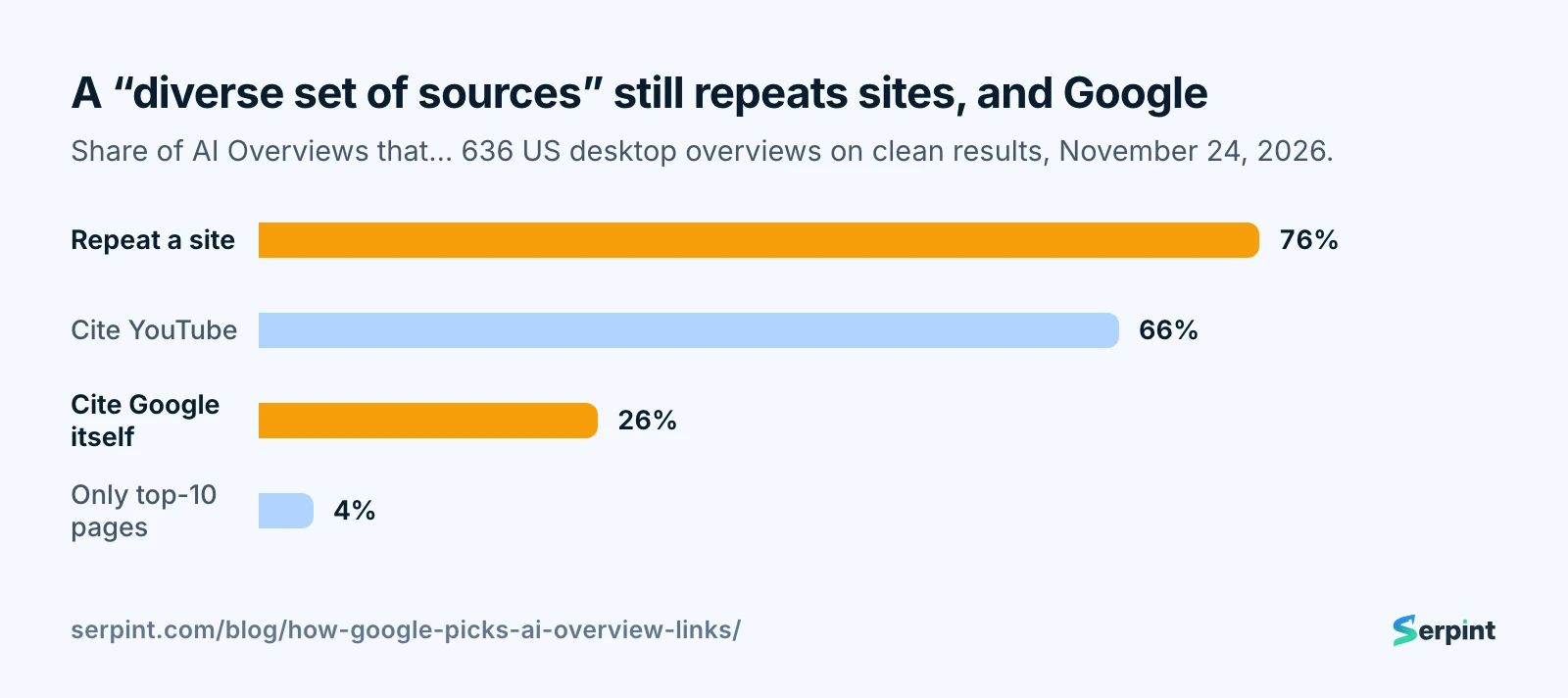
Data: Serpint’s check of 1,500 US desktop searches, November 24, 2026.
Those Google links are mostly “search for this” links back into Google results, not pages anyone wrote. They count as citations, but they send nobody to a website. Google also promises caution on sensitive topics, and that claim gave the most unexpected result.
Does Google hold back AI Overviews on health and money searches?
Google doesn’t hold back AI Overviews on health searches in our data; it shows them more often than average. In our November 16 run, 98.6% of health searches had an overview, against 84.7% for all 1,500. Finance was at 93.0% and insurance at 85.9%.
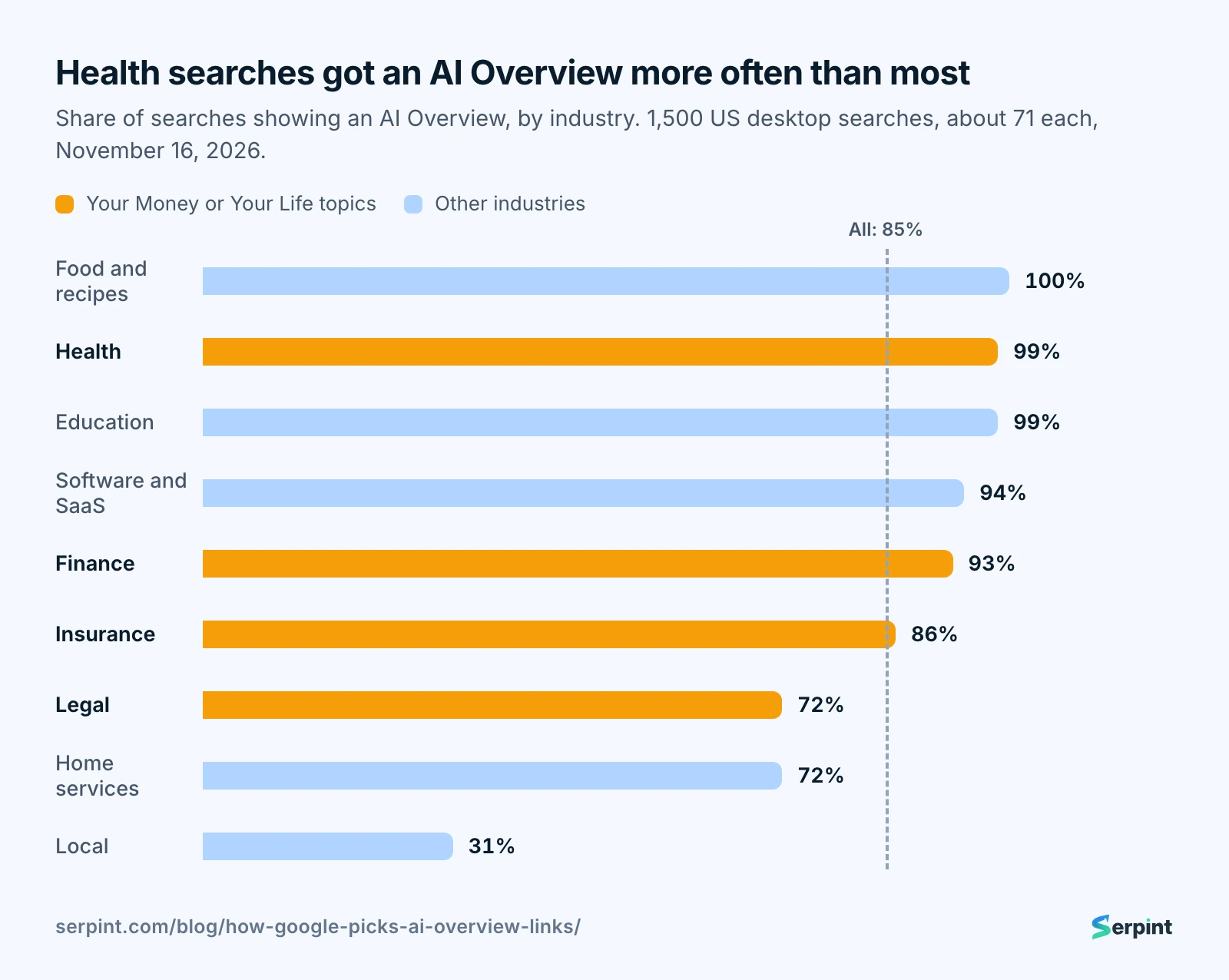
Data: Serpint’s check of 1,500 US desktop searches, November 16, 2026.
Legal searches (71.8%) and local ones (31.0%) got overviews least. My reading is that the “higher bar” is about what the answer says and which pages back it, not whether there is an answer. For health sites, that means competing on trust signals, since the overview is almost always there.
So the page holds up on rankings and is generous to itself on diversity and caution. What it asks of site owners is more useful.
What should you change on your pages?
You should change less than the AI-search advice industry suggests, because Google’s list is its ordinary Search advice. Four points on its page are worth acting on, each with what our data adds.
- Make sure the page can be cited. Only indexed pages that can show a snippet are eligible, and your site must stay included in generative AI features in Search Console. A
nosnippettag also keeps a page out of the overview. - Help readers trust the page. Google names clear sourcing, author pages and an About page. With overviews on 99% of health searches, that’s where the competition is for YMYL sites.
- Keep facts current, but don’t bump dates. Google says to change a page’s date only when the content changed substantially. I agree: a fake refresh is easy to spot, and it’s the kind of shortcut every 2026 update has closed.
- Watch the Generative AI report. Search Console counts how often each page was shown in AI Overviews and AI Mode, but not for which searches, and with no clicks.
✅ My advice Take your page’s main keyword and list the three questions a reader asks next. Answer each one on the page in a short section, so a fan-out search can land on you.
That last report is the weak spot: it won’t tell you which searches cite you or who got the link instead. That’s the part Serpint does.
How can Serpint show which of your pages AI Overviews cite?
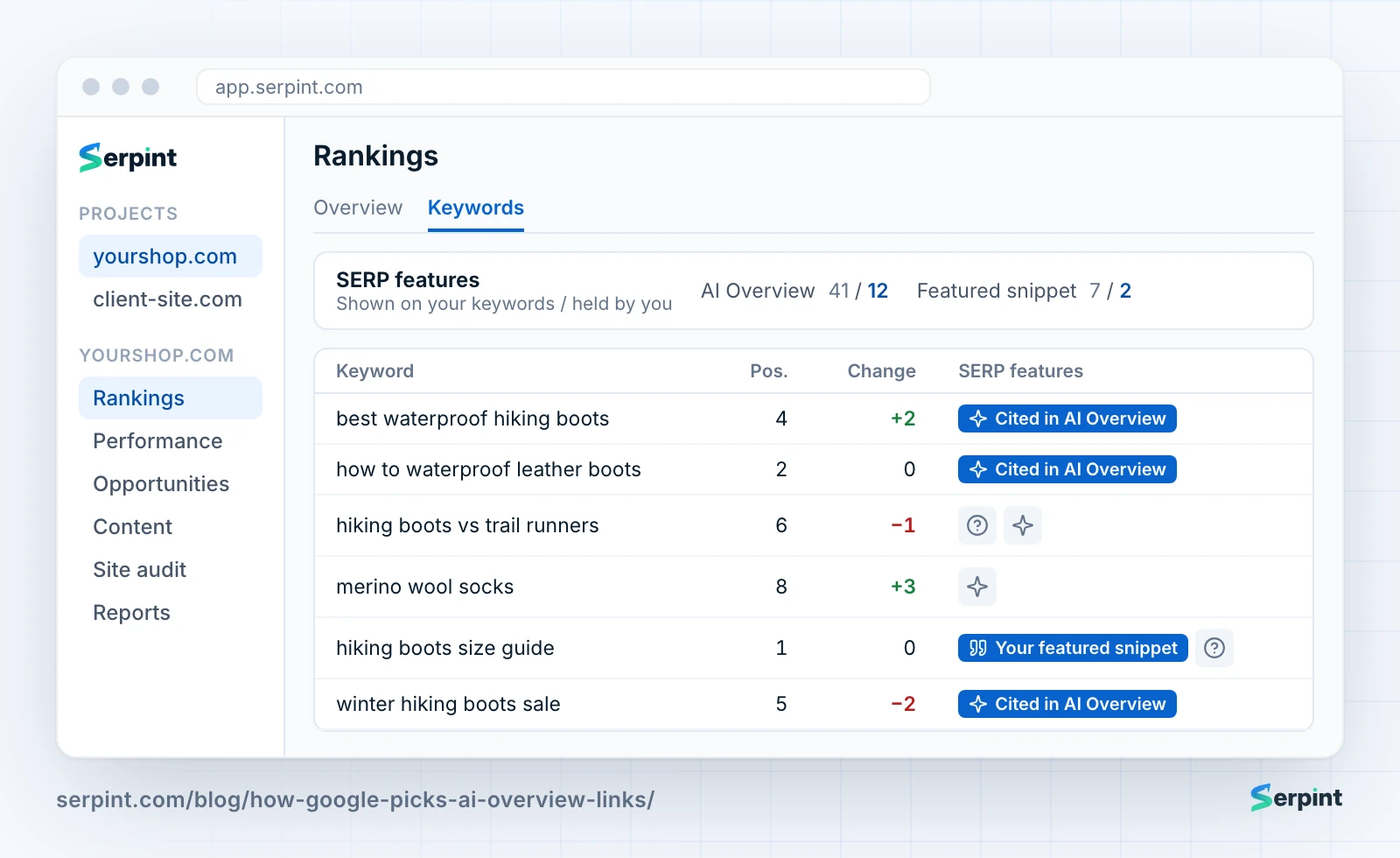
Serpint records, for every keyword you track, whether Google shows an AI Overview and whether it cites your site. The Keywords tab marks each one “Cited in AI Overview”, and the SERP features count shows how many of your keywords have an overview and how many cite you.
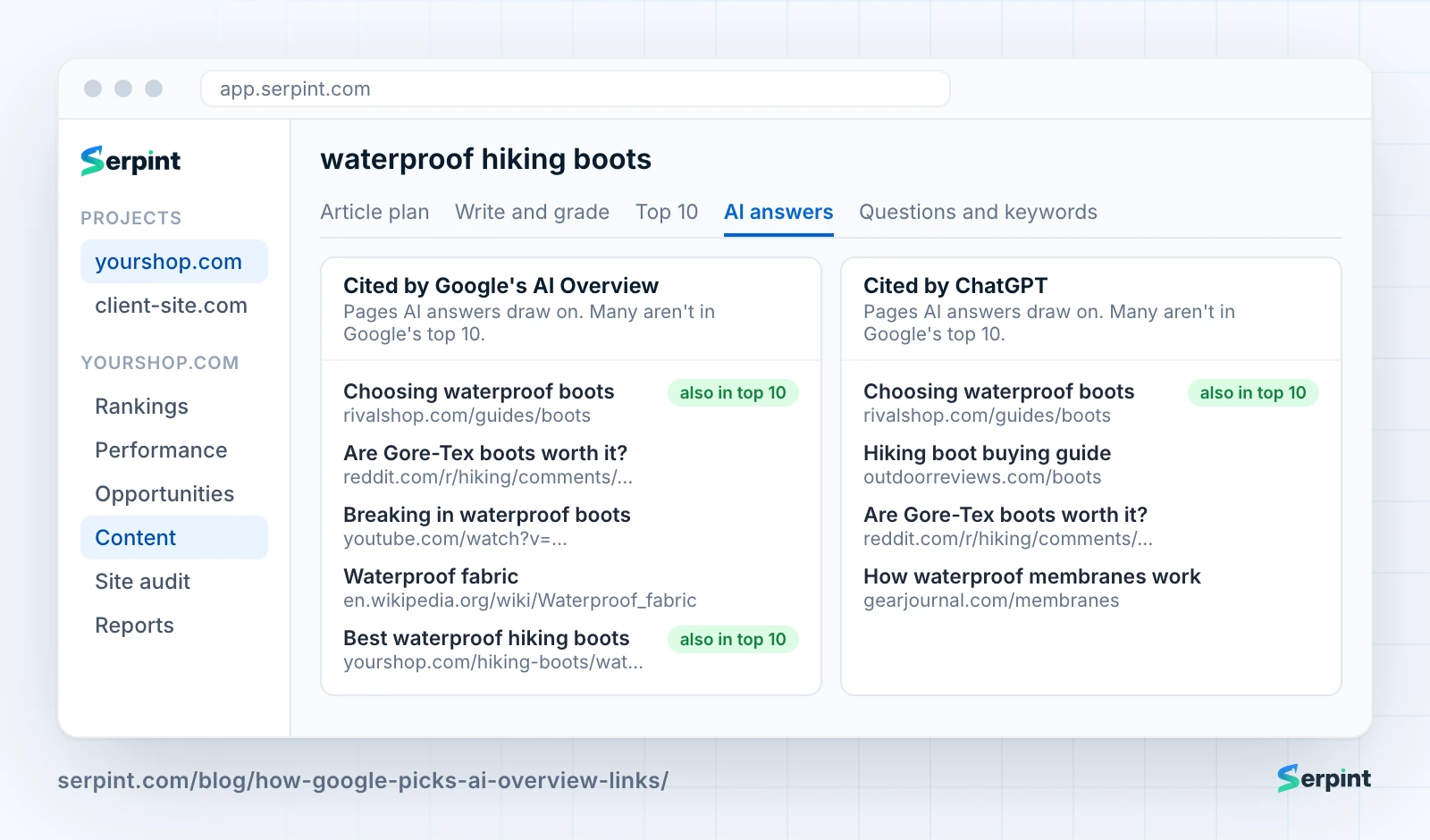
To see who got the link when it isn’t you, open a content brief for the keyword. Its AI answers tab lists every page Google’s AI Overview cites, marks the ones also in the top 10, and sets them beside ChatGPT’s sources. The pages that aren’t in the top 10 are your fan-out questions.
Opportunities lists the rest under “Snippets & AI”: keywords where you rank in the top 10 but the overview doesn’t cite you. Which of those to fix first depends on your kind of site.
What does it mean for your kind of site?
The same rules play out differently by kind of site, because overviews and YouTube show up unevenly.
- Publishers and blogs: you’re already in the pool if you rank. Add the follow-up questions to your articles, and consider a short video for how-to topics, where YouTube was in 82% of overviews.
- Online stores: YouTube matters less on price and brand searches (under half of overviews). Product pages, reviews and comparison content that rank carry more weight there.
- Local businesses: only 31% of local searches showed an overview, so the map pack and your Business Profile still come first.
- Health, finance and legal sites: overviews are nearly always there on health and finance. Author pages, sourcing and accuracy are what separate the cited pages from the rest.
None of these numbers is final, and some things the page leaves out we couldn’t measure.
What don’t we know yet?
We don’t know how much of this holds in AI Mode, which Google’s page also covers. Our data is AI Overviews on US desktop, from short keyword searches on one afternoon, and AI Mode works from longer conversations with more fan-out.
We also don’t know what the related searches are. Google doesn’t show them, so we can only see their results: the links to pages that don’t rank. We’ll re-run the same 1,500 searches in December, after the December 2026 core update, and compare them with these.
What should you do now?
Start with the keywords where you already rank, since those are the overviews you’re closest to. In order:
- Check which of your keywords show an AI Overview and whether it cites you.
- For the ones where you rank but aren’t cited, read the overview and note the questions it answers that your page doesn’t.
- Add those answers to the page in short sections, without changing its date unless the content really changed.
- For how-to and comparison topics, make a short video and link it from the page.
- Confirm in Search Console that your site is still included in generative AI features.
Founder of Serpint
Founder of Serpint. 6+ years in SEO and content marketing and 2 in GTM engineering, most recently as Head of Product and Content at lobstr.io, a B2B SaaS web scraping platform, until October 2026. Writes about SEO, AEO and GEO, the full stack of search and AI answer optimization, and content marketing.