News
Google's November 2026 core update is live: wait it out
Google's November 2026 core update started on November 10. What 2026's earlier updates rewarded, how long to wait, and how to measure what it did to your site.

· 14 min read
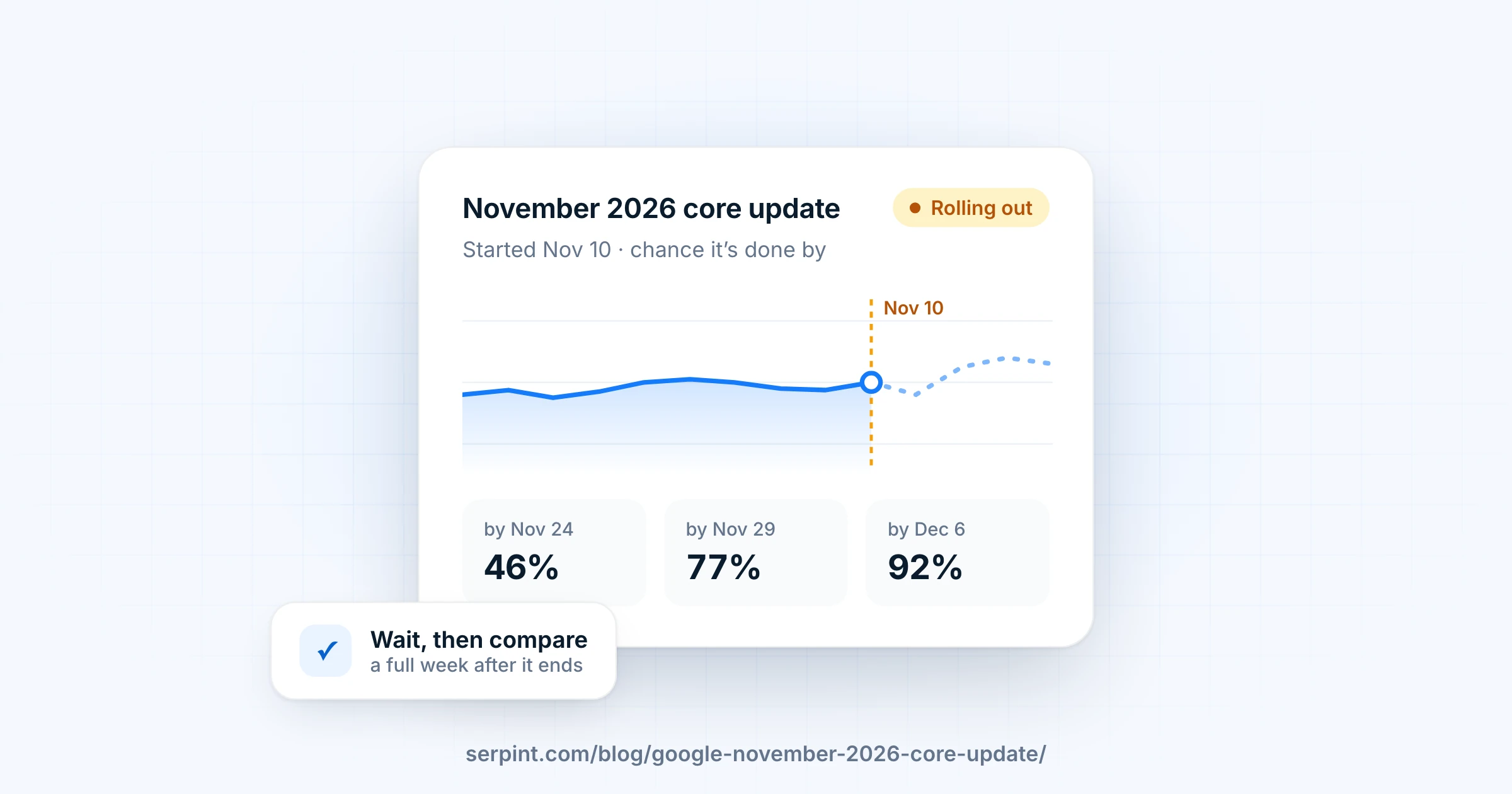
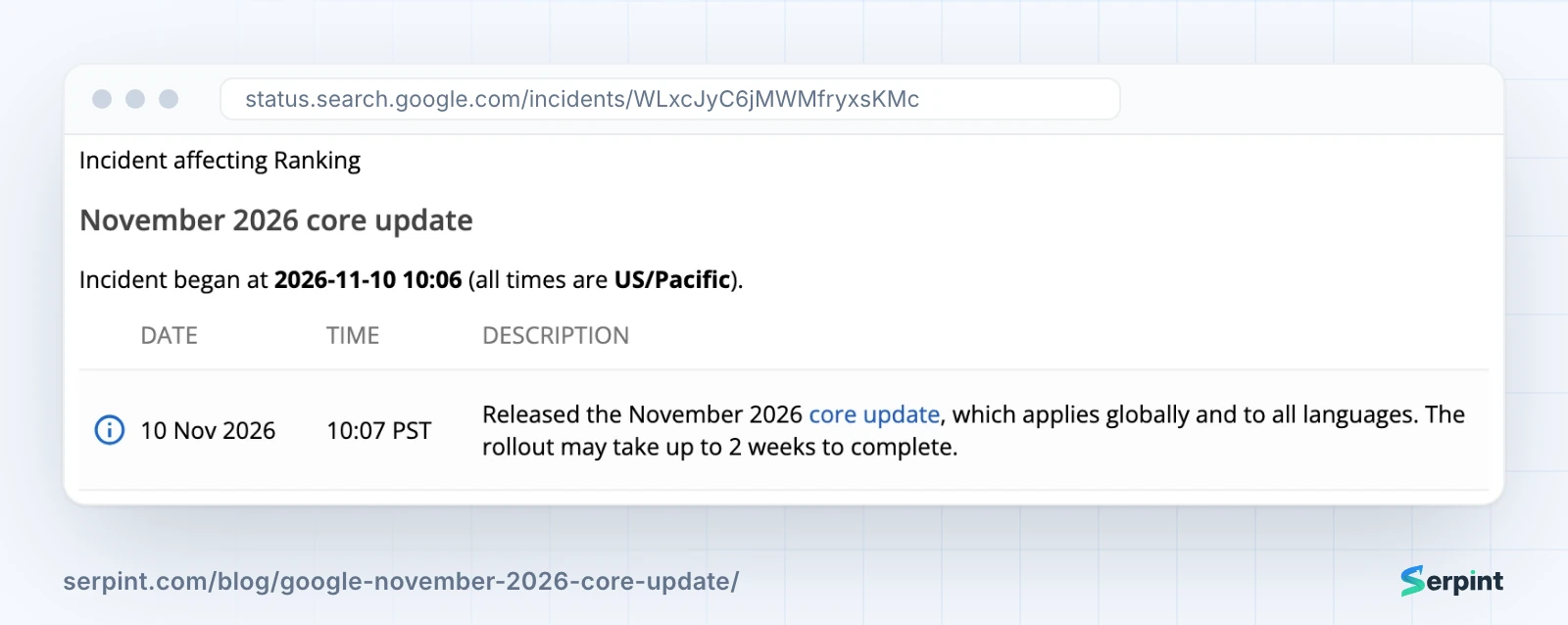
Google started rolling out the November 2026 core update at 10 a.m. Pacific on November 10, 2026. It applies worldwide, and Google expects it to take up to two weeks. This year’s two earlier core updates both rewarded the original source over the sites that summarize it.
✅ My advice Change nothing until Google marks the update complete. Then compare the first full week after it with November 3 to 9, page by page.
To guess what this one might do, start with what a core update is.
What is a Google core update?
A Google core update is a broad change to how Google ranks results across the whole web. It doesn’t target particular sites or pages. When a page drops, Google hasn’t penalized it: other pages now look more helpful for the same searches.
Google compares it to a friend’s list of favorite restaurants, rewritten as new places open. A restaurant that slips down the list isn’t bad. Others simply earned a spot above it.
Google’s announcement of this one gives nothing away: “a regular update designed to better surface relevant, satisfying content.” The best clues are the year’s earlier updates.
How did Google’s 2026 updates go?
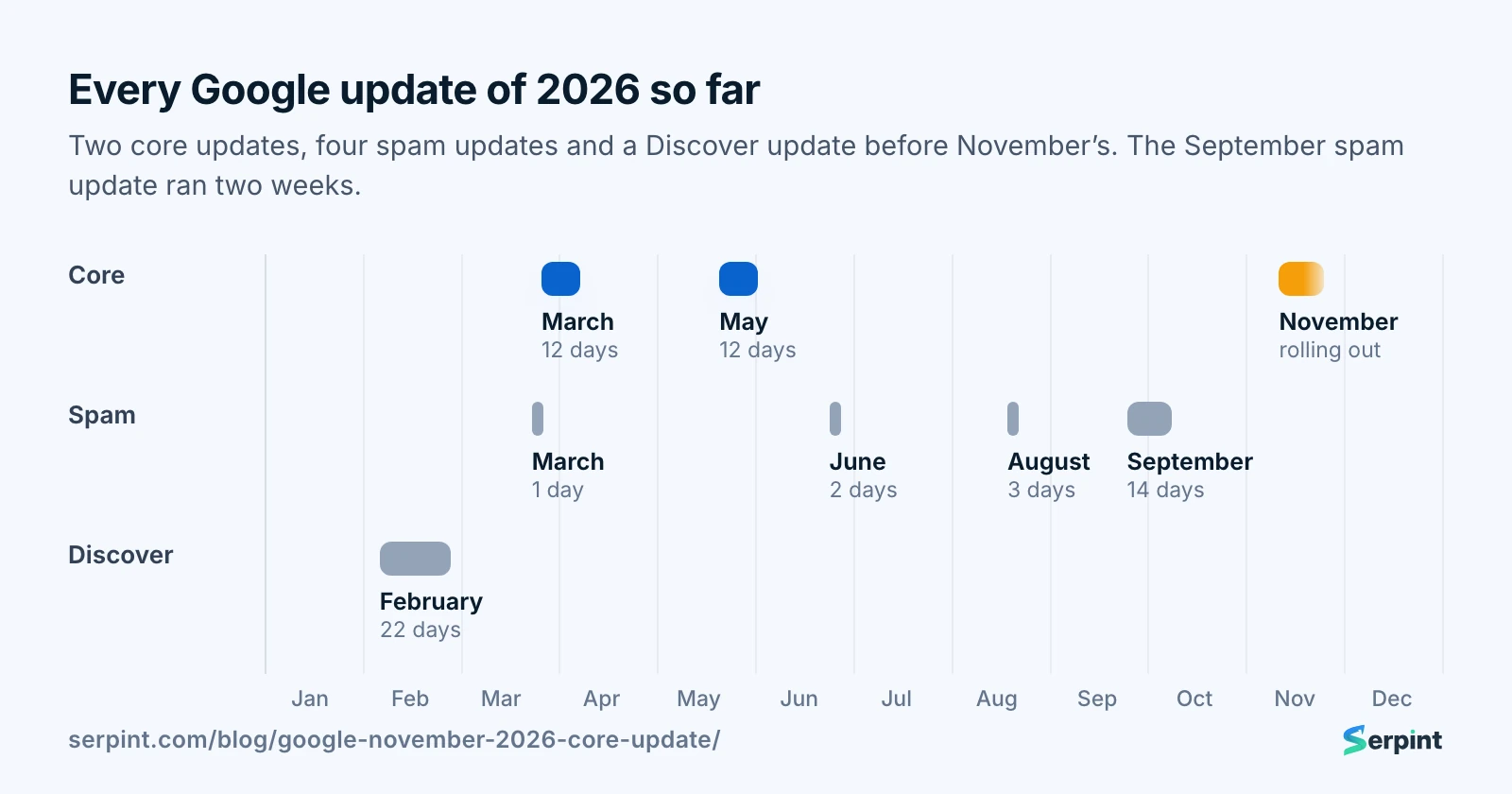
Google shipped seven updates in 2026 before this one. There were core updates in March and May, spam updates in March, June and August, and a September spam update that ran two weeks, from September 24 to October 8. A Discover update ran in February.
To read them, start with what came before: two years in which Google leaned on forums.
Why were forums winning before 2026?
Google spent 2023 and 2024 rewarding first-hand experience, and forums were full of it. Reddit went from the 68th most visible site in Google’s US results to the 5th between July 2023 and July 2024. Its visibility grew 14 times in that year.
The run lasted into this year. Reddit’s visibility peaked in October 2025, and in our data its estimated Google traffic still grew 10% from November 2025 to February 2026.
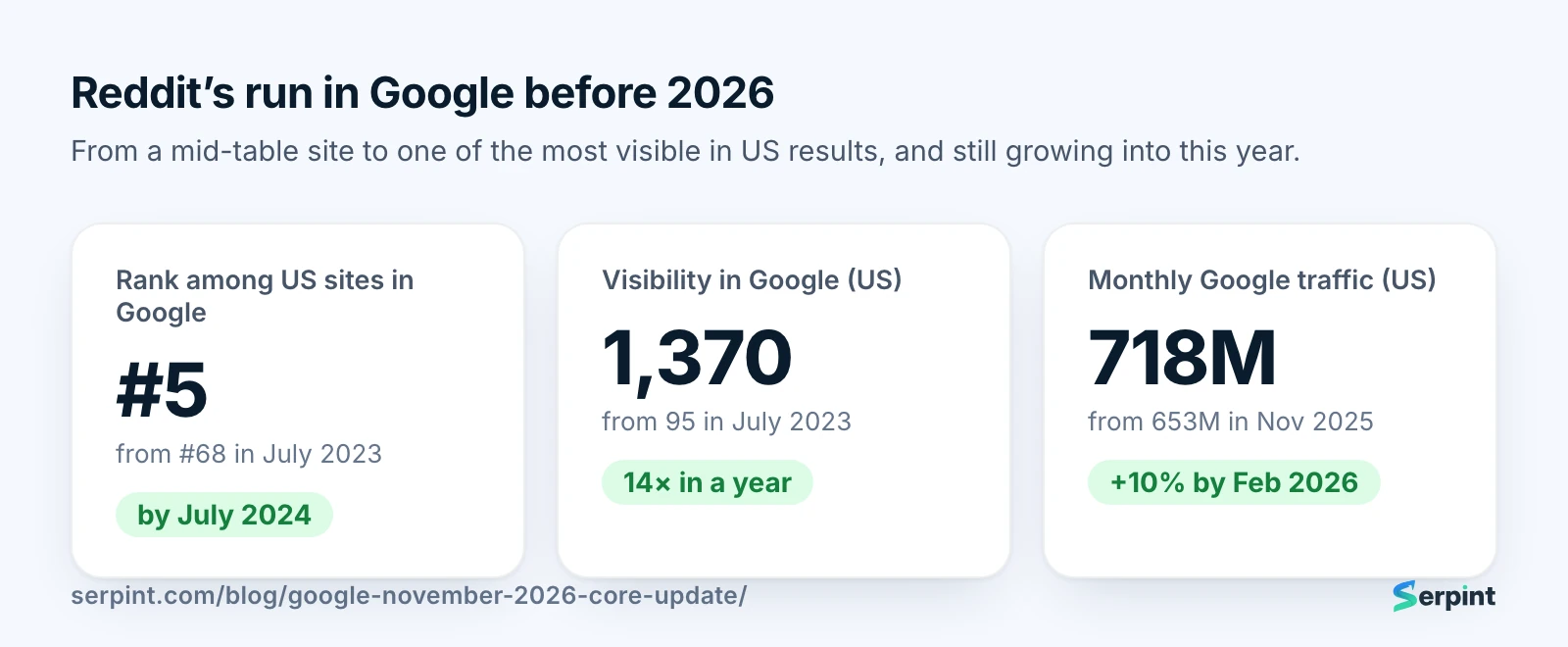
Rank and visibility: Sistrix. Traffic: Serpint’s estimates for Google US.
Then March arrived.
What did the March 2026 core update change?
The March 2026 core update (March 27 to April 8) turned the tide on platforms where people talk about things. In Sistrix’s visibility data, YouTube, Reddit, Instagram and X lost the most, along with review sites like Tripadvisor and Yelp.
The winners mostly owned the thing being searched for: IMDb, Netflix and Spotify, hotel chains and airlines, and government sources like the NIH. Google sent people to the source, not to the conversation about it.
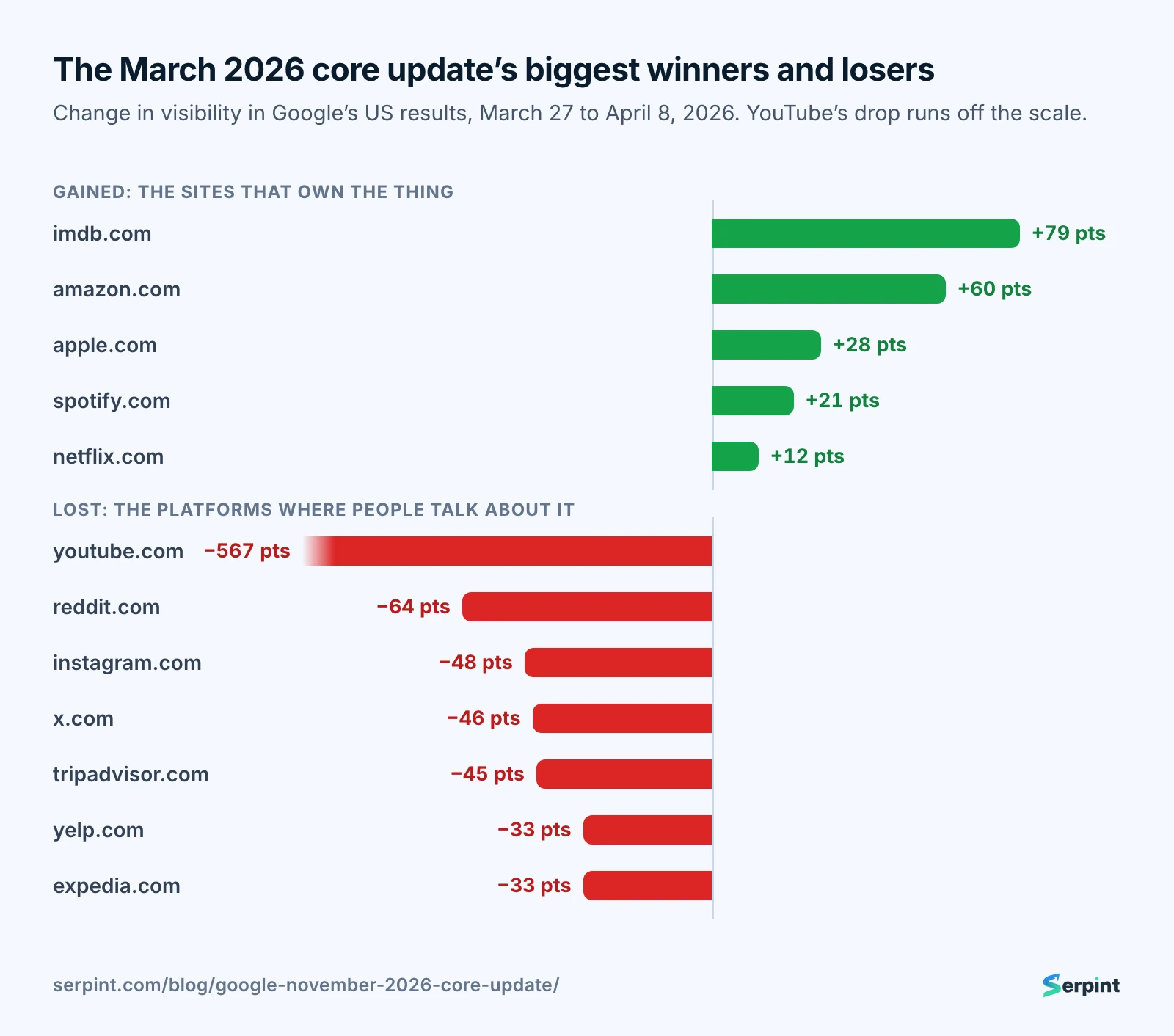
Data: Sistrix visibility index, US.
Our own data shows the same split. Across the update, every discussion site we measured lost more top-10 rankings than every site that owns the answer. Stack Exchange lost 14% of its top-10 rankings, Quora 11% and Reddit 5%, while Marriott gained 10% and the NIH 3%.
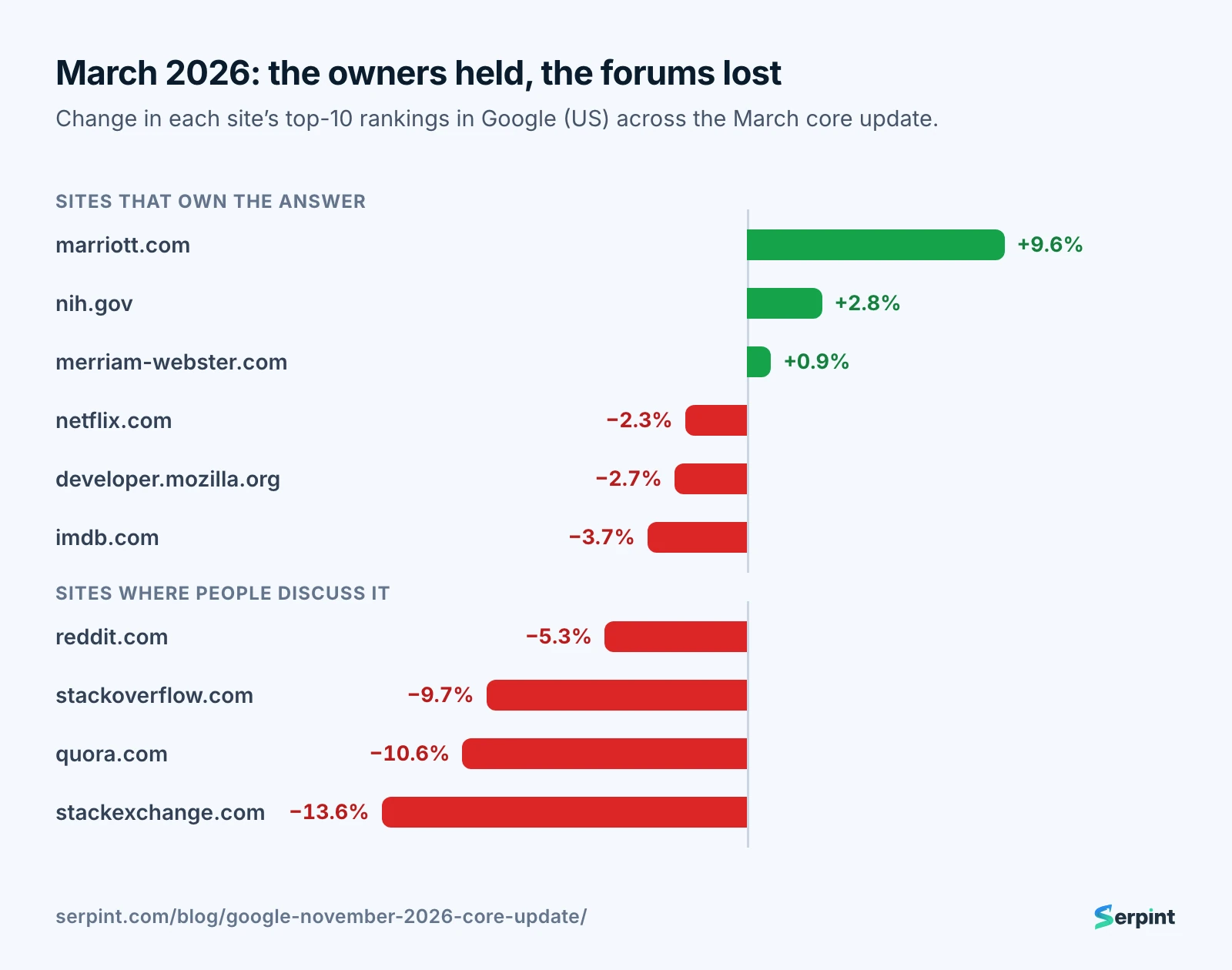
Data: Serpint’s ranking estimates for Google US, March and April 2026.
May then asked a sharper question than “who is the source?”
What did the May 2026 core update change?
The May 2026 core update (May 21 to June 2) sorted results by fit, not fame. In Sistrix’s UK and US data, the site that best matched each search’s intent and market won, even over names like the New York Times and Nature.
Dictionaries like Cambridge gained while the pronunciation and dictionary tools around them fell. Forums and Q&A sites lost about a quarter of their UK visibility. Job and travel marketplaces, where people finish the task, came back from their March losses.
Market fit counted too. In UK results, amazon.co.uk rose 21% while amazon.com fell 55%.
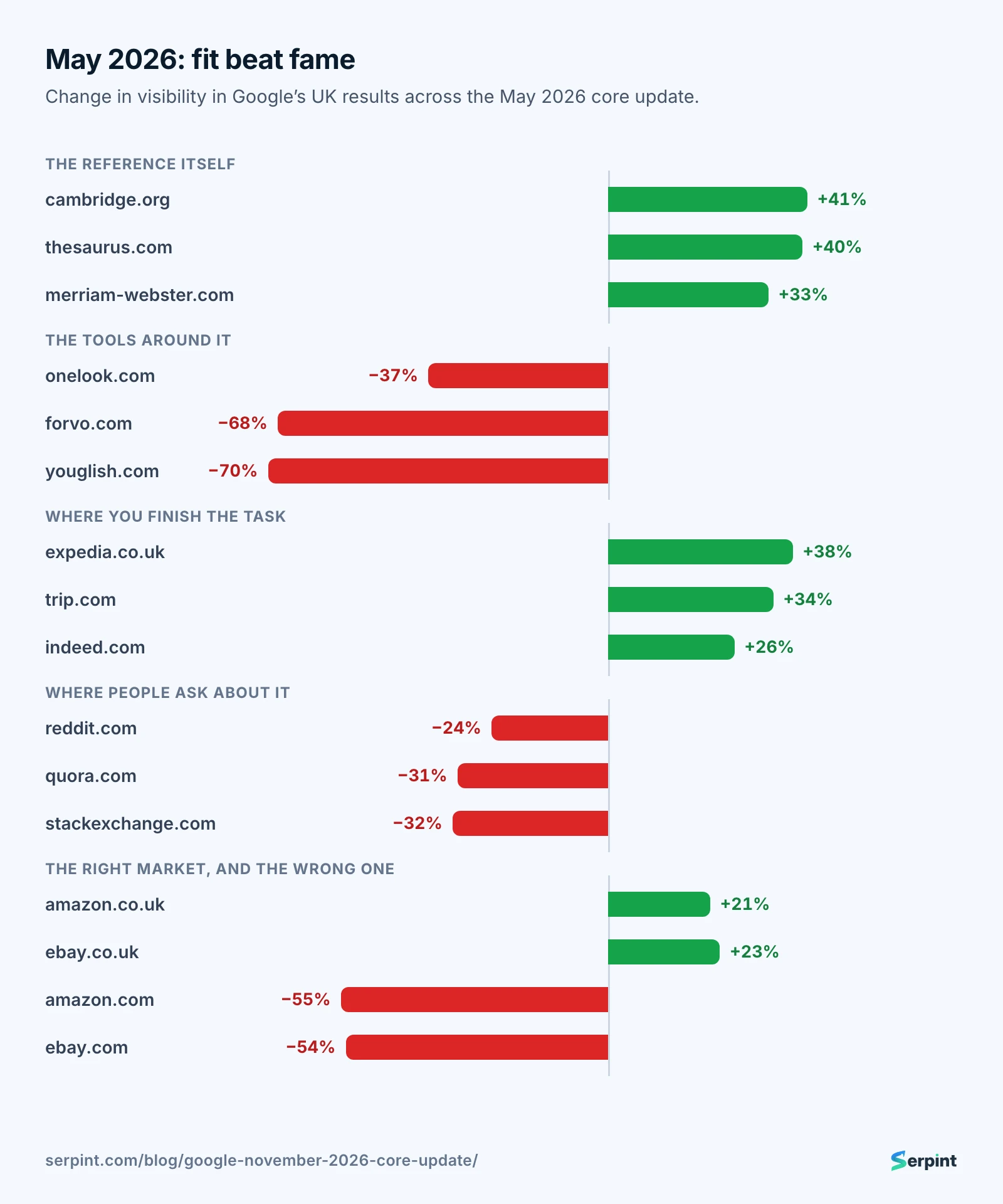
Data: Sistrix visibility index, UK, May 26 to June 2, 2026.
What happened to Reddit?
Reddit didn’t collapse; it narrowed. Since January it holds 10% fewer top-10 positions, yet 11% more top-3 positions, and its estimated Google traffic is flat. Google now puts Reddit on page one for fewer searches, and higher where real experience is the answer.
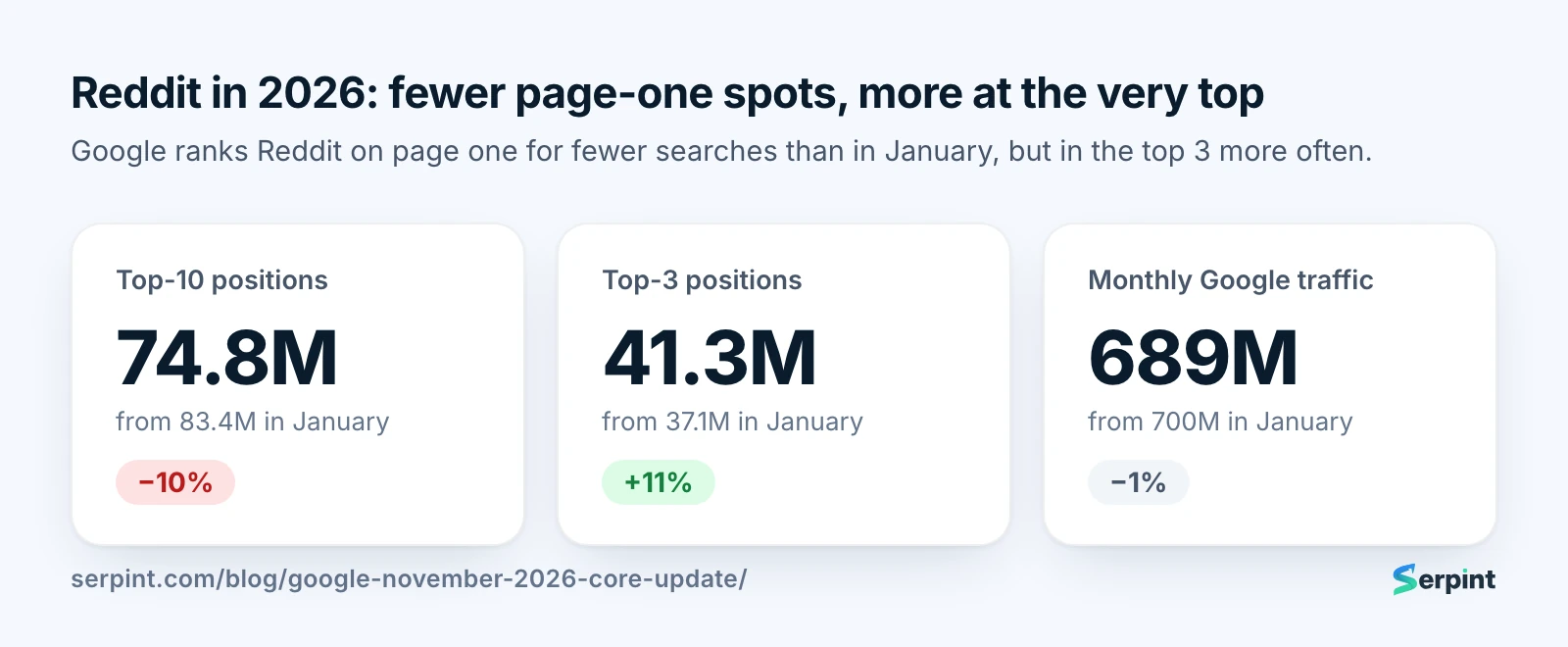
Data: Serpint’s estimates for Google US, January and November 2026.
What did the spam and Discover updates do?
Google never says what a spam update targets. Case studies of sites hit in August found the same thing in each: pages made at scale, whether programmatic, AI-written or thin affiliate pages. September’s spam update ran two weeks, long for one.
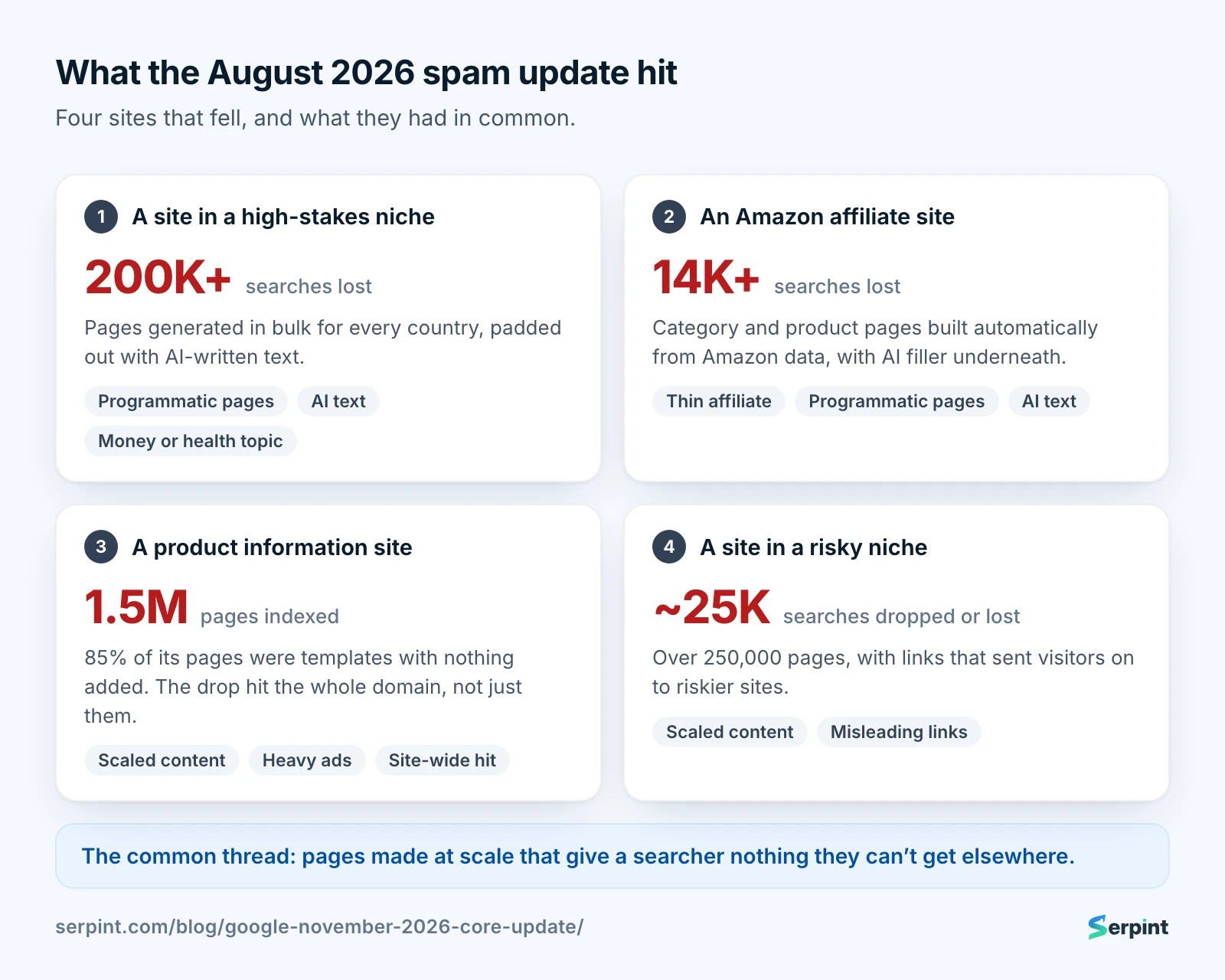
Four sites hit in August 2026, from published case studies.
February’s update changed Discover only, not search results. It’s the first time Google has run a core-style update just for the feed.
💡 My take Every 2026 update closed a shortcut. Spam updates cut pages made at scale, and both core updates cut the layers between a searcher and the source. Ranking for a search now means being the page that search is really looking for, not a page about it.
That pattern is the best guide to what November will do.
What will the November 2026 core update change?
Nobody knows yet, so these are my bets from the year’s pattern. I’ll check each one against the data once the rollout ends.
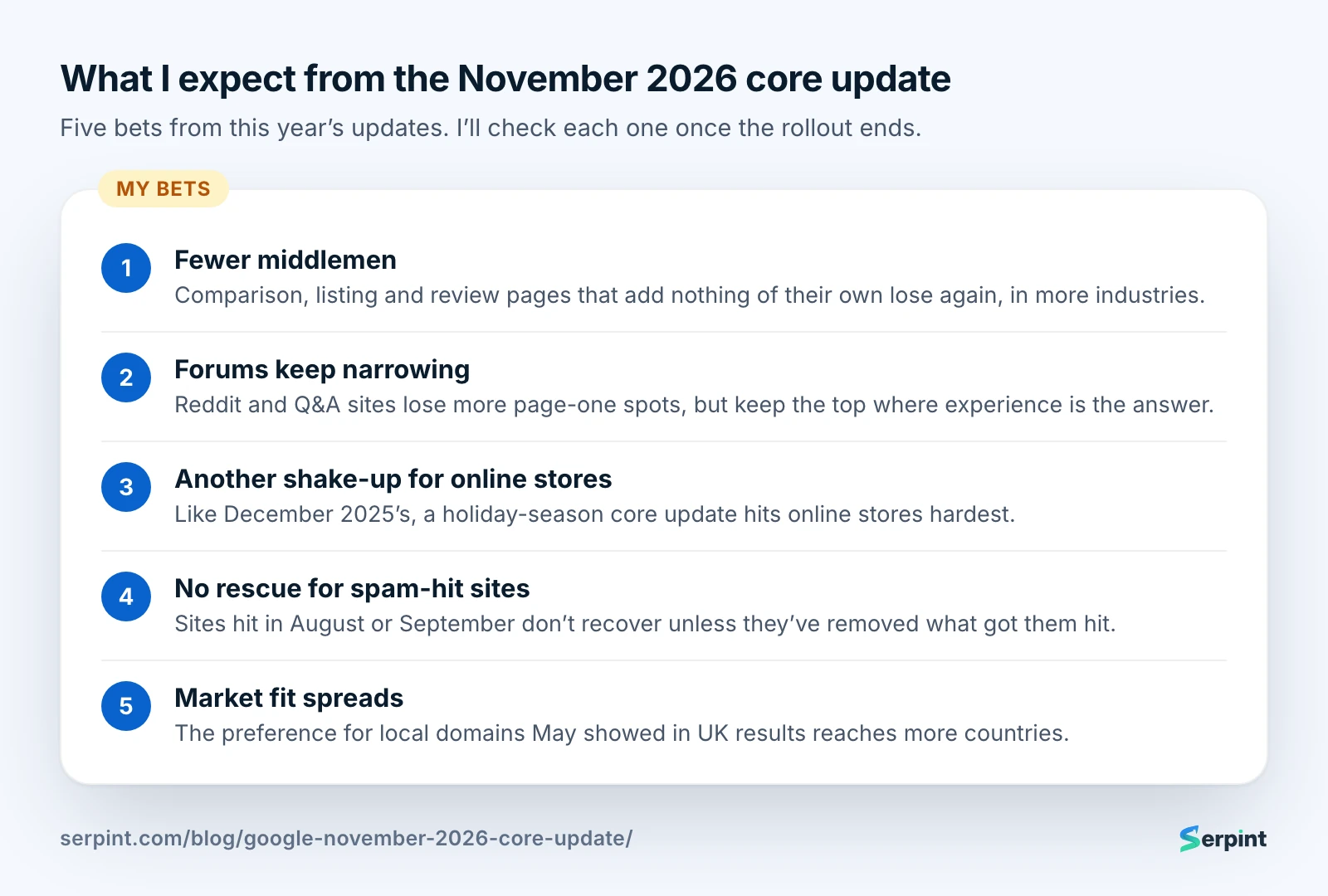
- Fewer middlemen. In our data, every discussion site lost more top-10 rankings in March than every site that owns the answer, and May hit the tools around dictionaries. I expect comparison, listing and review pages that add nothing of their own to lose again, in more industries than travel and jobs.
- Forums keep narrowing. Since January, Reddit holds 10% fewer top-10 positions in our data, but 11% more top-3 positions. I expect forums and Q&A sites to lose more general searches, and keep the top spot where real experience is the answer.
- Another shake-up for online stores. Last December’s core update, also in the holiday season, landed hardest on online stores. This one overlaps Black Friday, and I expect stores to feel it most again.
- No rescue for spam-hit sites. Spam updates and core updates are separate. A site hit in August or September won’t climb back in this core update unless it has removed what got it hit, and even then recovery takes months.
- Market fit spreads. In May, UK results moved from global domains to local ones: amazon.co.uk rose 21% while amazon.com fell 55%. I expect that to reach more countries, so each market’s searches should land on that market’s pages.
Whichever of these lands, the first question is how long you’ll wait to find out.
How long will the November 2026 core update take?
Plan for late November or early December, not November 24. Google says up to two weeks, but 7 of its last 13 core updates ran longer, and the median took 16 days.
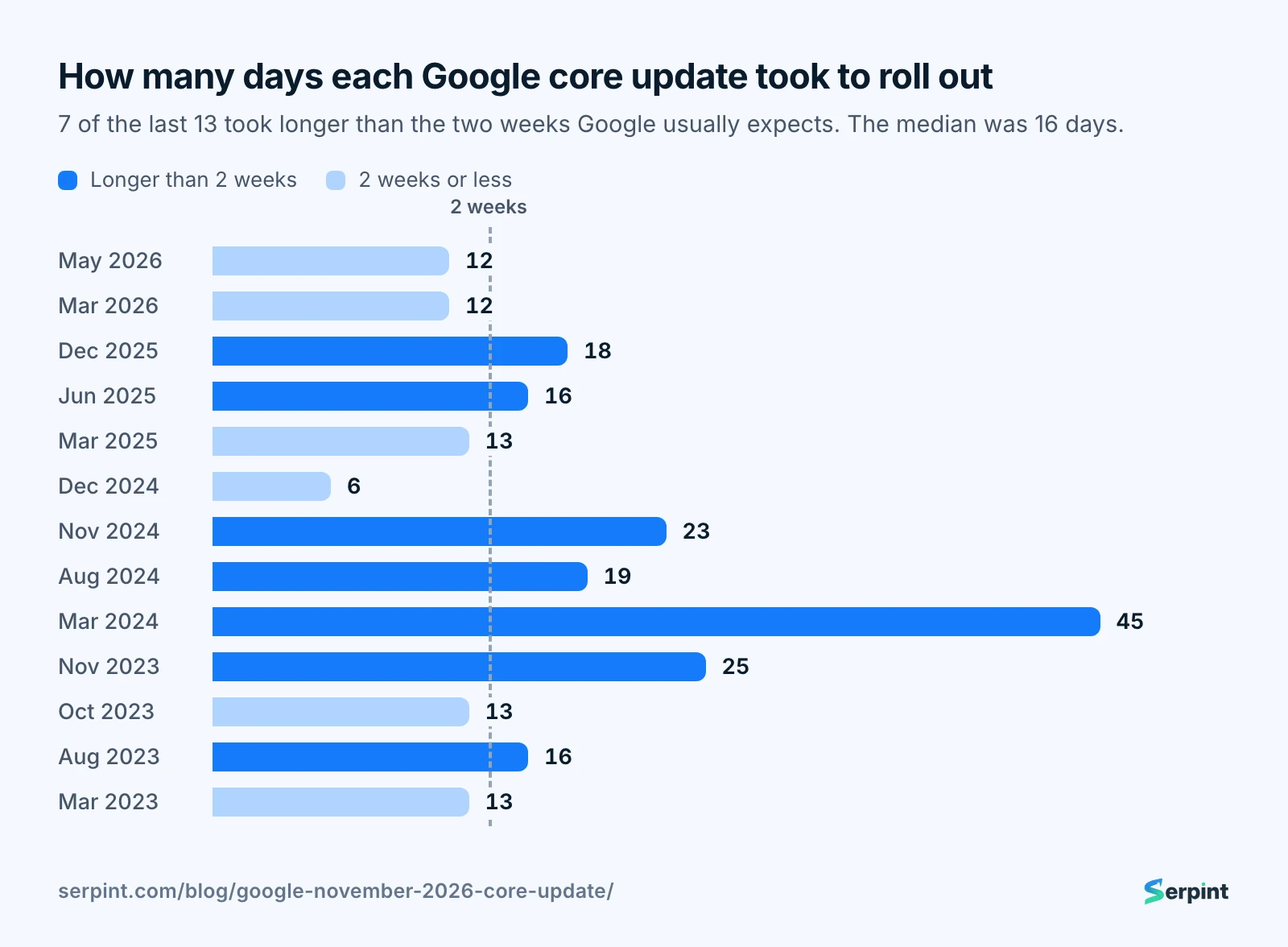
Start and end dates from Google’s Search Status Dashboard.
On that record, it’s a coin flip (46%) whether this one ends by November 24, and 92% that it’s done by December 6.
Two weeks or four, the rollout is when you’ll feel the most pressure to do something.
Should you change anything while it rolls out?
No. Leave pages that already perform well alone, as Google itself recommends. Rankings swing from day to day during a rollout, and a dip on Monday can reverse by Friday.
✅ My advice Treat the rollout like wet paint: look, don’t touch. Write down November 10, and check the Search Status Dashboard every few days for the end date.
Edits made now also spoil your measurement. If a page moves next week, you won’t know whether the update moved it or your edit did.
I also wouldn’t trust any winners-and-losers list in the first week. Those lists catch the swings, not where things settle: Reddit’s estimated traffic was back above its January level by June.
The day Google marks it complete starts the only clock that matters.
When should you check your traffic?
Check your traffic one full week after the rollout ends, as Google advises. Compare that first week after with the week before the update began, November 3 to 9, in Search Console’s Performance report.
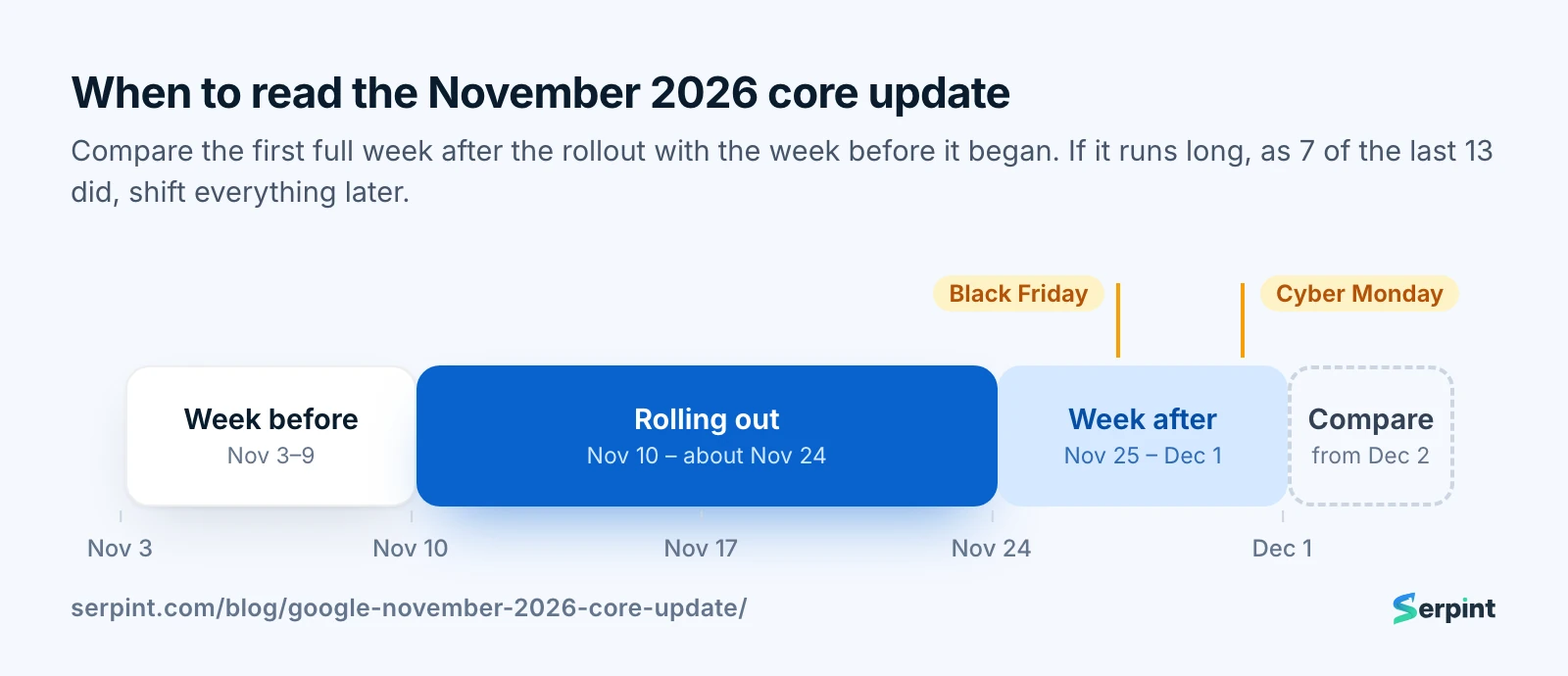
If the rollout runs long, every date after it moves later by the same amount.
If the rollout ends on November 24, your week after is November 25 to December 1, and you can compare from December 2.
Search Console’s data runs two or three days behind, so the full week shows up around December 3 or 4. If the rollout ends later, shift the whole plan.
Search Console does the comparison in two steps.
How do you compare the two weeks in Search Console?
Compare the two weeks in Search Console’s Performance report with a custom date comparison. Open Performance, click the date filter, choose the Compare tab, then Custom, and enter the week after against November 3 to 9.
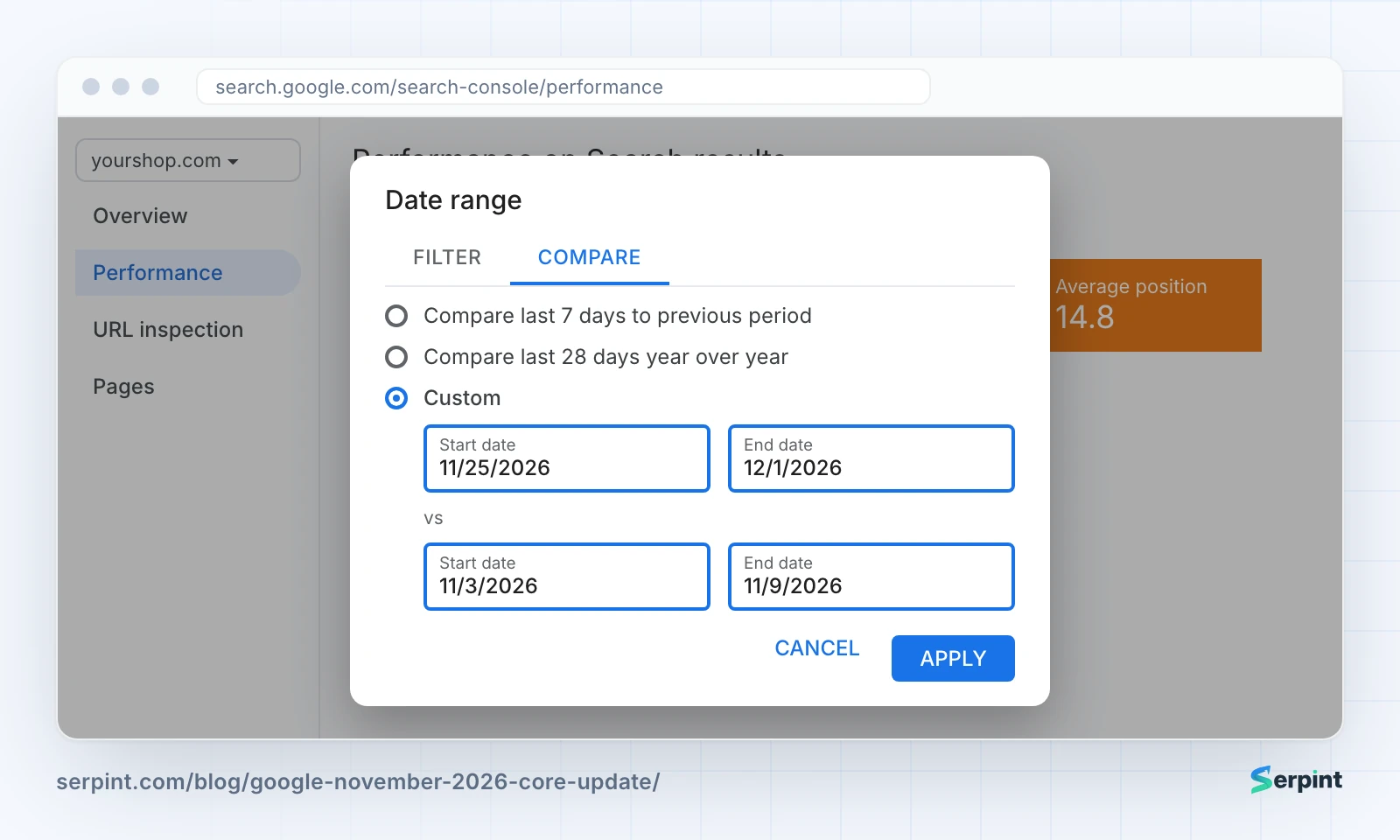
Step 1: the two weeks, in Search Console’s date filter. Redrawn with sample data.
Then open the Pages tab, turn on Average position, and sort by Clicks Difference. Your biggest losers rise to the top, with their position in both weeks beside them.
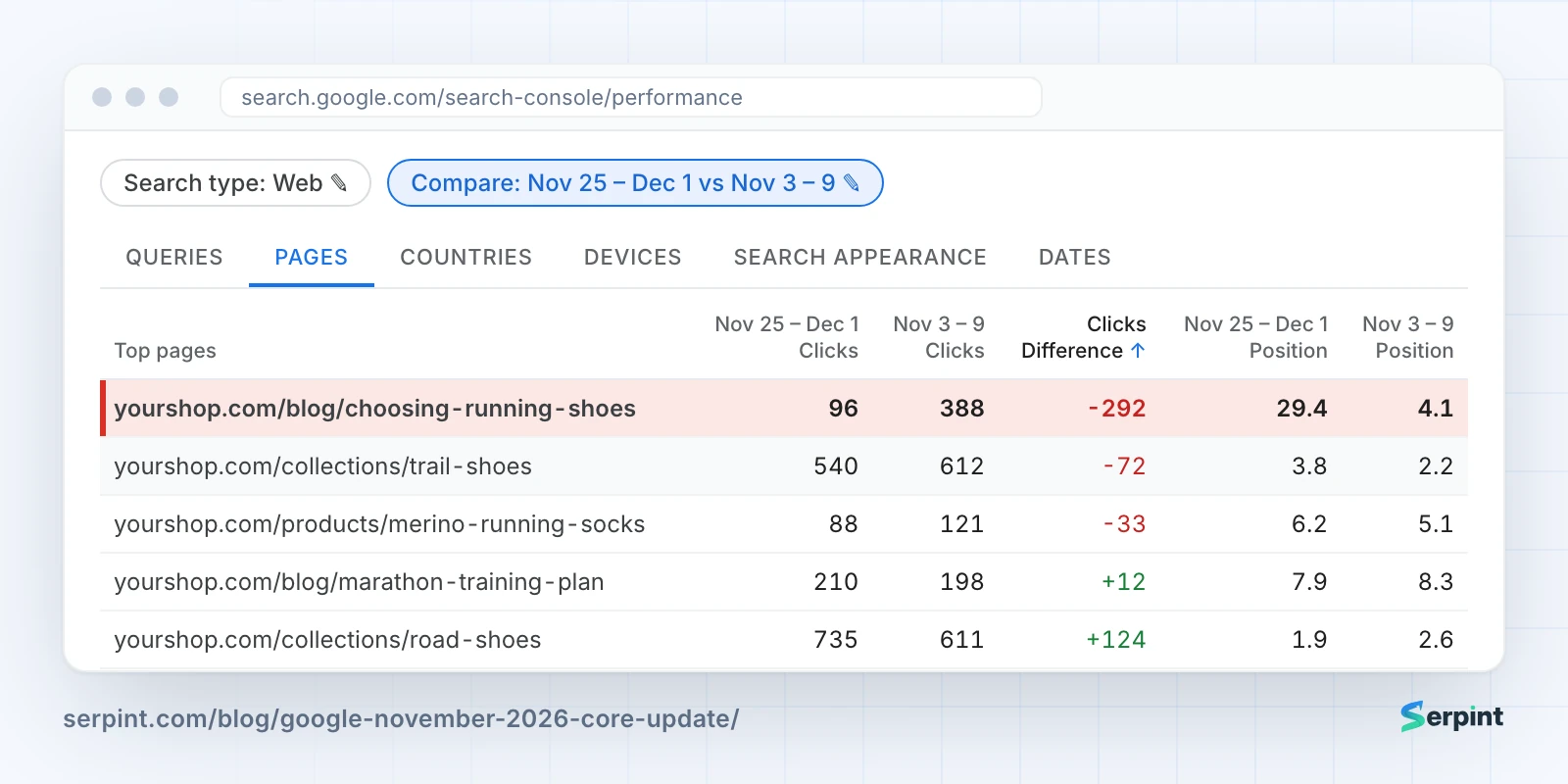
Step 2: pages sorted by the clicks they lost. Redrawn with sample data.
Read the result page by page, not from the site total. Google draws a clear line. A slide from position 2 to 4 is normal movement and needs no drastic action. A fall from position 4 to 29 needs a closer look.
In the example, the trail shoes page can wait, and the running shoes guide can’t. Repeat it for each search type, since Web, Images, Video and News can move differently.
Most sites will find a few pages that moved and a total that barely did. A smaller group will find the whole site down.
What if your whole site lost ground?
If the whole site lost ground and stays down, read Google’s self-assessment questions on helpful, people-first content. Our guide on what to check after a website traffic drop walks through every step.
Then apply this year’s lesson. For each search you lost, look at what ranks now: a brand’s own page, a marketplace, a dictionary, a video. If Google now prefers a different kind of source, polishing your page won’t win it back. Adding what only you have might.
Google also warns against quick fixes, like removing a page element because someone blamed it. Real improvements can take months to show, sometimes not until the next core update.
That’s a calendar to keep, two date ranges, four search types and a page-by-page sort, for every site, after every update. It still won’t tell you whether a drop came from Google or from a change on your own site. Serpint answers both.
How can Serpint tell Google’s updates from your own changes?
Serpint puts Google’s updates and your own changes on the same traffic chart. Its Performance page shades every confirmed update, core updates in amber. It pins what changed on your site: N for a new article, R for a refreshed page, and grey for pages changed elsewhere, read from your sitemap.
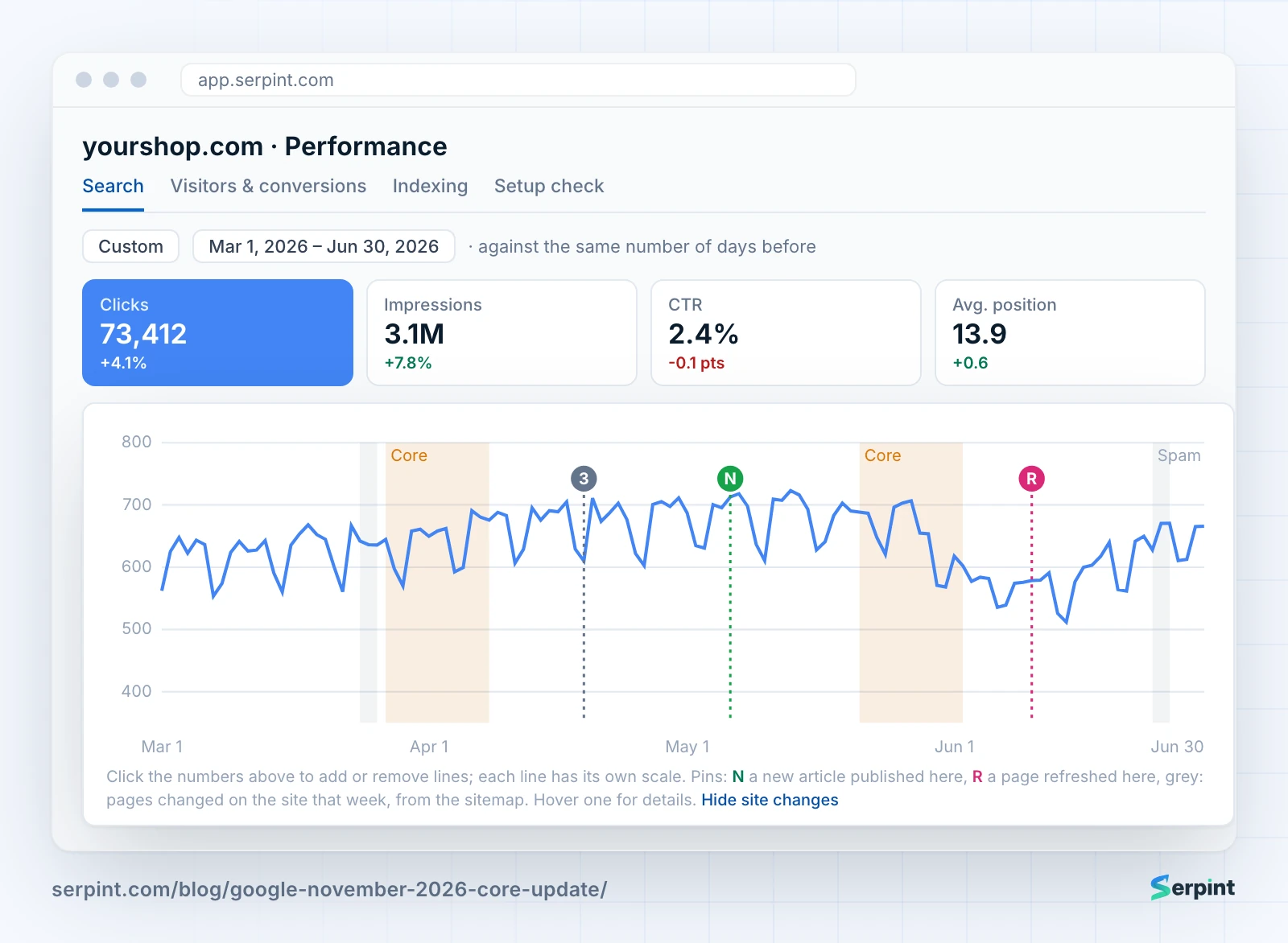
So when clicks fall, you see at a glance whether an update was rolling out, or whether someone changed the pricing page that week. Hover a pin and it names the pages.
While an update rolls out, every project shows a banner with the day it’s on.
A week after it ends, Serpint measures it for each site against that site’s own trend over the four weeks before, so normal growth isn’t read as a win. It uses Search Console clicks, else GA4 organic sessions, else your tracked keywords.
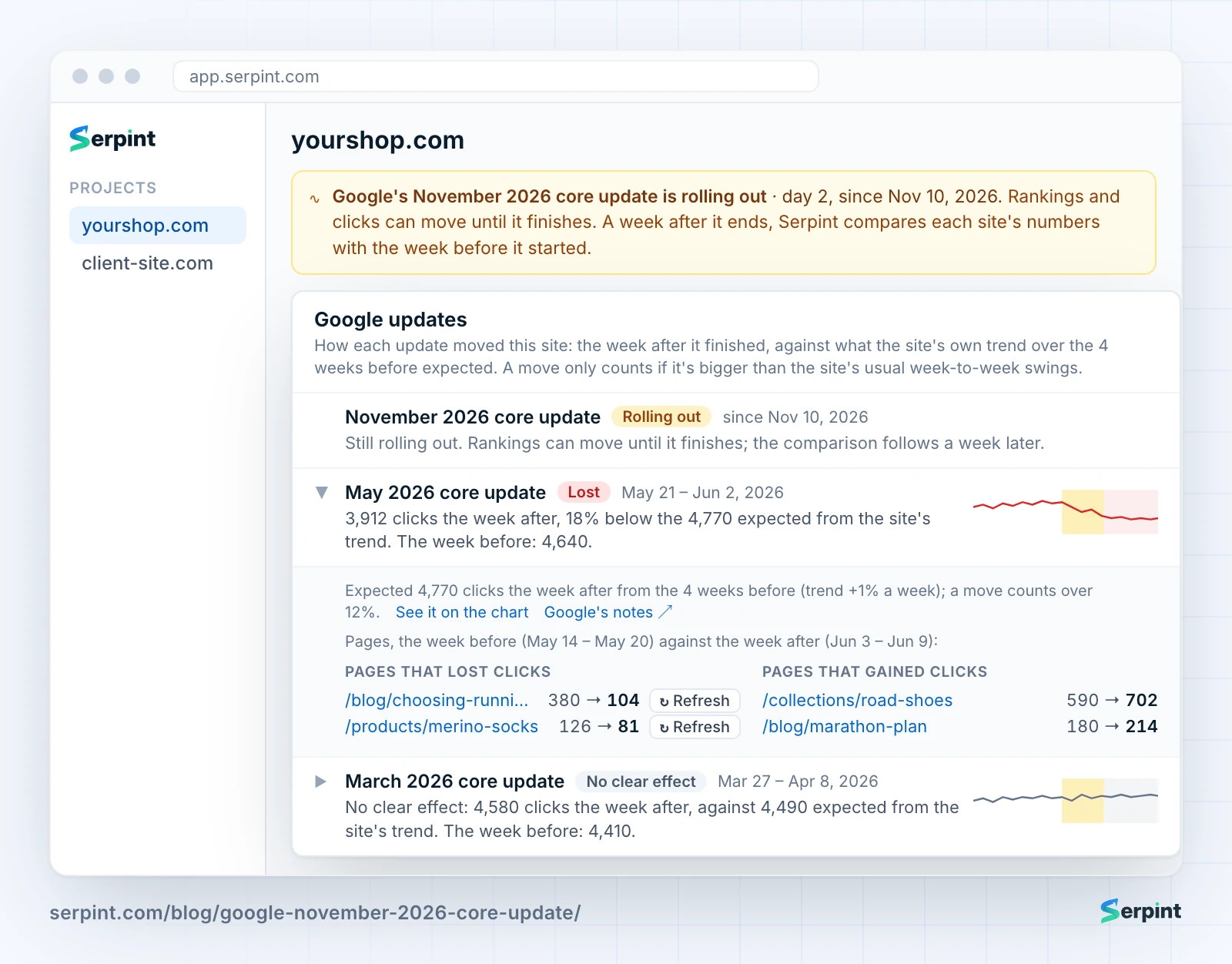
The card lists the pages that gained and lost clicks, and the tracked keywords that rose and dropped. Each losing page has a Refresh button to grade and rework it, and Serpint then follows that page week by week against the four weeks before.
An email arrives once the results are in. The projects page shows how the update moved every site, and your monthly client reports name any update that hit. Link Search Console and you see how every update of the last 16 months moved your site, straight away.
What the result means still depends on the kind of site you run.
What does it mean for your kind of site?
Online stores have the hardest comparison this year. The week after a November 24 finish holds both Black Friday (November 27) and Cyber Monday (November 30). Shopping demand moves traffic on its own, and no trend line knows about Black Friday.
✅ My advice If you run a store, also compare last year’s Black Friday week, then December 2 to 8, the first ordinary week.
Stores selling in several countries should check that each market’s searches land on that market’s pages. In May, UK results moved from global domains to local ones.
Affiliate, comparison and review sites have lost in both 2026 core updates. A page that lists other people’s products needs its own reason to exist: tests you ran, prices you track, photos you took.
Publishers should check Google Discover and the News tab on their own. Core updates can move both, and a site’s web search traffic can hold while Discover drops.
SaaS and B2B sites should look at blog pages and product pages separately. Informational articles often move differently from pricing and feature pages, and only one of them may need attention.
Agencies should tell clients now that the real result arrives in December, not this week. Mark November 10 in every client report, so a dip isn’t blamed on the work.
Whatever your site, a few things are still unknown to everyone.
What don’t we know yet?
Nobody outside Google knows yet who gained or lost. Rank tracking tools saw heavy swings in the days before the announcement. Sistrix plans to publish its first data on affected domains from November 16.
We’ll update this post with the end date, and again once the first week after shows what moved.
What should you do now?
Start by writing down November 10 and leaving your best pages alone. Check the Search Status Dashboard every few days for the end date.
Then, once the rollout ends, wait out the first full week. Compare it with November 3 to 9 in Search Console, page by page and search type by search type.
Finally, act only on the big drops, the 4-to-29 kind. Look at what now ranks in your place, and add what only you have, rather than rewriting for the sake of it.
Founder of Serpint
Founder of Serpint. 6+ years in SEO and content marketing and 2 in GTM engineering, most recently as Head of Product and Content at lobstr.io, a B2B SaaS web scraping platform, until October 2026. Writes about SEO, AEO and GEO, the full stack of search and AI answer optimization, and content marketing.